

Binary to Grey Code Truth Table Explained
Learn how to convert binary numbers to Grey code using truth tables 📊. Understand their link, see practical examples, and explore uses in digital systems 🔧.
Edited By
Emily Bennett
Grey code and binary code are both methods to represent numerical values in digital systems, but they differ significantly in their structure and applications. While binary code is the most common system used in computers and digital electronics, grey code is designed to reduce errors during transitions between successive numbers by changing only one bit at a time.
Understanding how to convert grey code to binary code is essential for engineers, traders dealing with algorithmic hardware, investors interested in tech-driven markets, and students delving into computing fundamentals. This knowledge underpins effective processing of sensor readings, rotary encoders, and error correction in communication systems.
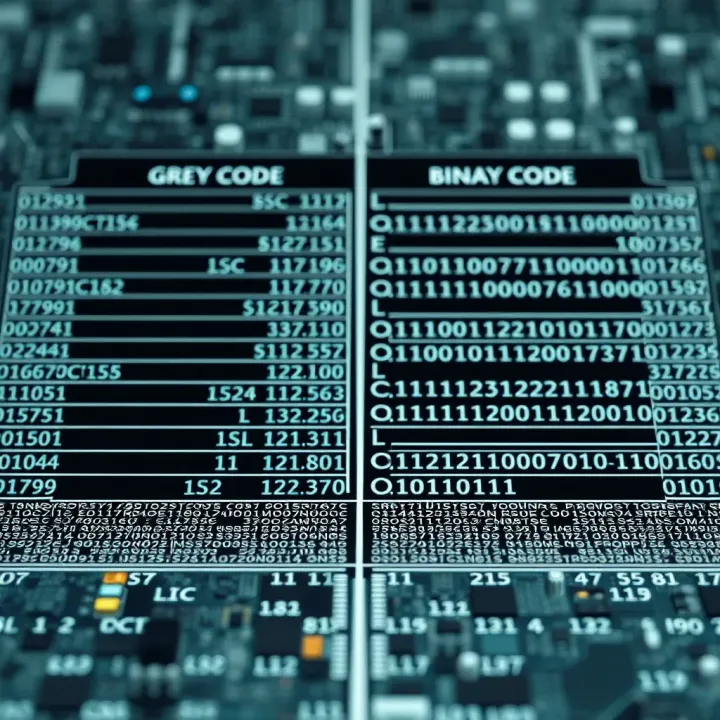
Grey code, also called reflected binary code, differs from regular binary as only one bit flips when moving from one number to the next. For example, moving from 3 (0011 in binary) to 4 (0100) involves flipping multiple bits, but in grey code, it would be a single-bit change. This characteristic minimises glitches and errors when signals change state, making grey code popular in hardware applications.
Most processors and software work with binary numbers. Therefore, converting grey code readings from sensors or encoders into binary is necessary to interface with standard digital systems. Without this conversion, data interpretation could be inaccurate, leading to faulty outcomes.
Converting grey code to binary involves a straightforward logical operation:
The most significant bit (MSB) of the binary code is the same as the MSB of the grey code.
For each following bit in the binary code, perform an XOR (exclusive OR) between the previous binary bit and the current grey code bit.
Grey code: 1101
Binary MSB = 1 (same as grey MSB)
Next binary bit = 1 XOR 1 = 0
Next binary bit = 0 XOR 0 = 0
Last binary bit = 0 XOR 1 = 1
Binary code = 1001
This transformation ensures that data obtained from devices using grey code can be interpreted accurately by binary-based digital systems.
In the coming sections, we'll explore the practical applications, challenges, and tools that help automate this conversion in real-world electronics and computing projects.
Understanding grey and binary codes forms the foundation for grasping how digital systems represent and process information. In this article, we focus on how to convert grey code to binary, but before that, it’s vital to understand what these codes are, how they work, and why one might be preferred over the other in specific scenarios.
Grey code, also known as reflected binary code, is a binary numeral system where consecutive numbers differ by only one bit. This property makes grey code useful in situations prone to errors when multiple bits change simultaneously. For example, in rotary encoders used in industrial machinery, grey code ensures only one position bit changes at a time, reducing the risk of incorrect readings due to mechanical misalignment or timing variations.
Binary code is the standard way digital devices represent data, using combinations of 0s and 1s. Each bit in a binary number has a weight that is a power of two, making the system ideal for arithmetic computations and data processing. For instance, CPUs and memory modules store and manipulate data in binary format because it aligns directly with electronic circuit states.
The main difference between grey and binary codes lies in bit changes between adjacent numbers. While binary code can change multiple bits between numbers (e.g., from 3 (011) to 4 (100)), grey code changes only one bit at a time. This reduces errors in systems sensitive to bit switching noise. However, grey code is not straightforward for arithmetic operations, which is why it often needs conversion to binary for further processing.
Grey code’s single-bit transition feature reduces errors during state changes, especially in mechanical or noisy environments. When multiple bits change simultaneously, small delays or glitches can cause erroneous readings. Grey code minimises this risk, making it crucial in precise measurement devices, such as shaft encoders and position sensors.
Apart from rotary encoders, grey code is well-suited in analogue-to-digital converters and error-correcting memory systems. It’s often used in scenarios where reliability trumps computational ease. For example, in some robotics applications, grey code ensures accurate position tracking even with minor signal disturbances.
Grey code simplifies error handling by limiting bit changes during state transitions, while binary code excels in straightforward arithmetic operations and broad computing tasks.
In summary, knowing the basics of grey and binary codes—and why grey code finds a niche in error-prone environments—helps you appreciate the need for efficient conversion methods between the two. This understanding serves as the stepping stone for the detailed processes discussed later in the article.
Converting grey code to binary is a fundamental task in many digital applications, especially where precision and error reduction matter. Understanding the process step-by-step helps investors, traders, analysts, and students grasp how data transitions between these two systems, boosting reliability in electronics and computing.

The first step in converting grey code to binary involves identifying the initial bit. This bit remains the same in both grey and binary codes. For example, if the first bit in grey code is 1, the first binary bit will also be 1. This initial bit acts as the starting point for decoding the entire binary sequence. Its correct identification ensures the conversion process maintains accuracy from the very beginning.
After fixing the first bit, the next binary bits are calculated by performing an exclusive-or (XOR) operation between the previous binary bit and the current grey code bit. This step is practical because it sequentially builds the binary number, reflecting the natural progression of grey code sequences where only one bit changes at a time. This method reduces errors that might occur during manual or automated decoding.
Consider the grey code: 1101. The first binary bit is taken as 1. To get the second binary bit, XOR the first binary bit 1 with the second grey bit 1, resulting in 0. Continue XORing sequentially: 0 XOR 0 = 0 and 0 XOR 1 = 1. Thus, the binary equivalent is 1001. This example clearly shows how simple XOR operations translate grey codes into binary numbers efficiently.
XOR is a logical operation that outputs true (or 1) when the inputs differ, and false (or 0) when they are the same. This property makes XOR ideal for converting grey codes because grey code sequences differ only by one bit between adjacent numbers. Applying XOR successively allows straightforward back-calculation of binary bits from grey code, saving time and reducing the chance of mistakes, especially in hardware implementations.
Mathematically, each binary bit (after the first) equals the XOR of all grey bits up to that position. This relationship means that knowing the grey code lets you reconstruct the binary number by cumulative XOR operations. Understanding this connection aids analysts and students in recognising the logic behind grey-to-binary conversion beyond just following steps — it reveals the inherent structure in the code sequences.
The step-by-step approach combining initial bit identification and XOR calculations forms the backbone of accurate grey to binary code conversion, crucial in digital electronics and computing systems where error-free data interpretation matters.
By mastering this process, readers can apply it confidently in real-world scenarios like data transmission, sensor readings, and more.
The conversion from grey code to binary holds practical importance across various fields, especially in electronics and computing. This process ensures data transmitted or sensed using grey code can be correctly interpreted and processed in binary-based systems, which remain the standard in digital technology. Let’s explore some key areas where this conversion proves essential.
Rotary encoders often use grey code outputs to indicate shaft positions because grey code changes only one bit at a time. This property reduces errors caused by mechanical misalignment or bouncing contacts during rotation. However, since most microcontrollers and processors work with binary code, converting grey code readings into binary becomes necessary for accurate position tracking.
In industrial machines or robotics, precise position sensing is critical for control and automation. For example, a motor shaft's position data encoded in grey must be converted to binary so the system can calculate angles or speeds reliably. The conversion process thus bridges the physical sensor output and the digital logic needed to perform further computations.
Grey code helps reduce errors in digital communication systems by minimising bit transitions, cutting down the chances of transient faults during data transfer. When data arrives in grey code, converting it to binary allows error checking and processing using standard algorithms designed for binary data.
In fibre optic communication or industrial signal transmission, even minor errors can lead to significant data loss. Grey to binary conversion enables systems to maintain accuracy by aligning sensor outputs with the expected binary protocol, ensuring the robustness of the communication link.
While grey code excels in error reduction, it is not well-suited for arithmetic operations because its values do not follow traditional binary progression. Once grey code data is converted into binary, arithmetic computations like addition, subtraction, or logical operations become straightforward and compatible with existing processors.
Consider a scenario where an embedded system reads sensor data in grey code but needs to perform calculations to determine average speed or cumulative distance. Converting to binary first ensures reliable and efficient arithmetic processing without complex modifications.
Hardware circuits often incorporate modules for grey to binary conversion to ensure smooth integration of sensors and communication devices producing grey code with digital processors expecting binary. These converters can be implemented using simple XOR gates, making the transition quick and efficient with minimal hardware overhead.
In real-time applications like automotive control systems or manufacturing dashboards, on-the-fly conversion in hardware prevents delays and ensures prompt response to changing signals. This seamless interface between grey-coded inputs and binary-implemented logic circuits enhances system reliability and performance.
Converting grey code to binary is more than a mere formality; it acts as a crucial link that enables error-resilient data encoding to fit within widely used binary processing frameworks.
Grey code minimises read errors in physical sensors but needs conversion for processing.
Conversion is vital for accurate control in rotary encoders and position sensors.
Transmitted grey code data must be converted to binary for error checking and standard processing.
Binary arithmetic requires data in binary format; grey code cannot support these operations directly.
Hardware-level converters enable real-time applications to function smoothly without latency.
Understanding these applications helps appreciate why knowledge of grey to binary code conversion is necessary, especially for investors or students interested in digital electronics, embedded systems, and computing fields.
Converting grey code to binary code efficiently demands the right tools and resources. Whether tackling manual computation or automating the process, access to helpful aids can avoid errors and speed up conversions. Software and online converters streamline the process, while manual calculation tools support better understanding and error checking.
Several web-based converters offer quick grey to binary translation by simply inputting the grey code string. These tools prove handy for students, analysts, or engineers working on projects where instant verification is needed. For example, websites dedicated to digital logic design or electronics education often provide free converters with clear interfaces and explanations.
These platforms save time and minimise human error during conversion, especially when dealing with long or complex grey code sequences. They also help traders or investors working with automated systems to verify encoding related to sensor data or digital inputs.
Programming environments like Python, C, or MATLAB have built-in or easily implemented routines for grey to binary conversion. One can write a simple function using bitwise XOR operations to convert grey code arrays directly within data processing scripts or embedded software for devices.
This integration is particularly useful for developers creating signal processing applications or hardware interface software. It allows seamless conversion as part of larger workflows, combining data input, conversion, and further analysis. For example, a trading system analysing sensor inputs might automatically convert grey-coded position data before running decision algorithms.
Truth tables remain a fundamental tool for understanding and manually converting grey code to binary. By listing all possible grey code inputs alongside their corresponding binary outputs, learners can visualise and confirm conversion rules.
For instance, students preparing for electronics exams or analysts checking device outputs can use truth tables to cross-verify results. This approach supports grasping how each bit in binary corresponds to specific conditions in grey code.
A frequent error during grey to binary conversion lies in misinterpreting the first bit. Since the initial binary bit equals the first grey bit, overlooking this often leads to incorrect results. Similarly, slipping on performing the bitwise XOR operation properly for subsequent bits is common.
Another pitfall arises in timing when physical devices generating grey code signals cause bit misalignments, resulting in faulty conversion. Being alert to these typical issues helps both beginners and professionals achieve accurate coding results.
Manual methods deepen comprehension but require care to avoid errors. Using both software tools and manual aids strikes a balance between efficiency and understanding in grey to binary conversion.
Understanding the challenges in converting Grey code to binary code is vital for anyone working with digital systems. These issues often affect the reliability and accuracy of data, especially in real-time applications such as sensors and communication devices. Addressing common pitfalls can save time and prevent costly errors.
Timing issues occur when signals change state faster than a circuit can accurately process them. In Grey to binary conversion, a delay or misreading of bits during transition can lead to incorrect binary output. For example, rotary encoders rely on Grey code to indicate position. If the electronic circuit reads bits too early, before all signals settle, it might convert an intermediate or wrong value. This glitch results in errors that can cause position tracking to fail or jump unexpectedly.
To avoid such mistakes, circuits often include timing buffers or synchronisers that ensure bits stabilise before conversion. Engineers carefully design these circuits to match the speed of data changes, improving the reliability of the conversion process in embedded systems and industrial controls.
Manual conversion from Grey to binary can be error-prone due to the logical steps involved. Since each binary bit after the first depends on the cumulative XOR (exclusive-OR) operations of previous bits, an oversight in any step affects the entire code.
For instance, a student or beginner manually converting Grey codes might misinterpret the XOR logic or swap bits mistakenly. This leads to wrong binary values, potentially skewing results in experiments or learning exercises. Using tools or automation reduces this risk, but understanding the manual method remains essential to grasp the underlying principle.
Grey code is excellent for minimising errors during bit changes, but it may not suit every application. Its main limitation lies in the complexity of arithmetic operations. Performing addition or subtraction directly on Grey code is cumbersome because it isn’t straightforward like binary.
Hence, systems requiring frequent numerical operations find Grey code limiting. For example, microprocessors or applications with intensive calculations prefer pure binary. Grey code mainly thrives in encoders or systems where position or state change tracking is essential, rather than direct computation.
When Grey code’s constraints hinder performance, alternatives such as binary-coded decimal (BCD) or pure binary may be preferred. BCD eases human reading by encoding each decimal digit separately, while pure binary suits arithmetic-heavy tasks.
Use Grey code primarily when reducing transition errors is a priority, such as in mechanical encoders or error-sensitive sensors. For pure data processing and arithmetic, stick to binary or BCD. It’s about matching the code system to the application’s needs rather than forcing a one-size-fits-all approach.
Conversion errors can often be traced back to timing glitches or misunderstanding the logic steps, so careful design and validation are key to reliable Grey to binary translation.
Learn how to convert binary numbers to Grey code using truth tables 📊. Understand their link, see practical examples, and explore uses in digital systems 🔧.

Explore how to convert binary numbers to Gray code with easy methods and examples 🔢. Understand its use in digital electronics and why it's preferred in circuits ⚙️.

Learn how to convert binary numbers to Gray code and why it's vital in digital systems. Explore practical uses, conversion steps, and examples for engineers & students 📊🔢
🔢 Learn how to convert binary numbers to Gray code to reduce errors in digital signals. Explore step-by-step methods, practical examples, and real-world uses today!
Based on 8 reviews