

Understanding Binary Tree Inorder Traversal
Explore binary tree inorder traversal with clear concepts, recursive and iterative methods, plus practical applications 🔍 Essential for computer science learners and pros alike.
Edited By
Sophie Harrison
Inorder traversal is a key method to visit nodes in a binary tree, following a specific left-root-right sequence. Unlike preorder or postorder traversals, inorder ensures that nodes are accessed in ascending order when applied to binary search trees, making it indispensable for many programming tasks and algorithms.
This traversal method begins by exploring the left subtree recursively, then processes the root node itself, and finally moves to the right subtree. This systematic approach allows for an ordered visit of nodes, which proves helpful in sorting and searching operations.
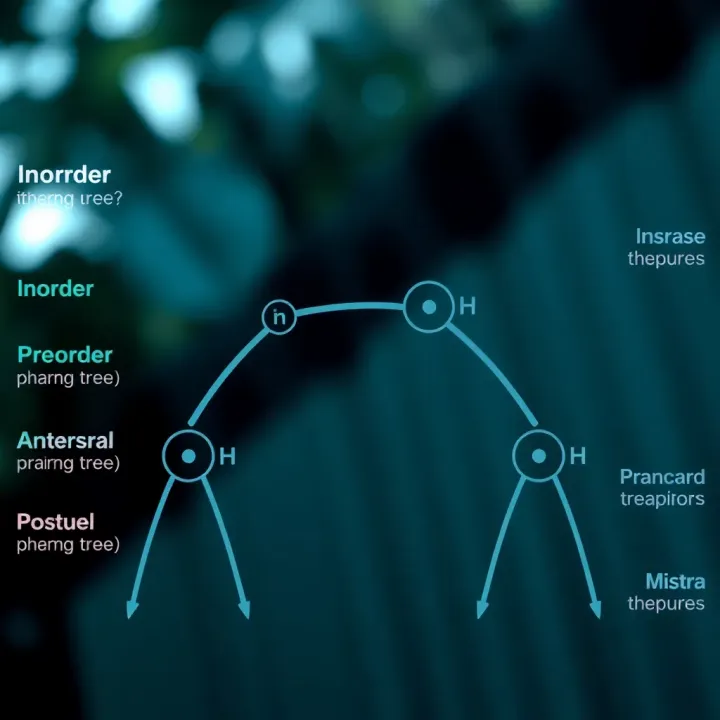
Consider a binary tree representing a family hierarchy or organisational chart; inorder traversal will traverse the left side (like older generations or departments), visit the head (root), and then the right side (younger generations or other departments). This analogy helps in understanding node visitation order practically.
Inorder traversal is widely used for retrieving data from binary search trees because it visits nodes in non-decreasing order, which is valuable for tasks like range searching, database indexing, and expression tree evaluations.
To implement inorder traversal, you generally use recursion or an explicit stack to track nodes:
Recursively visit left child
Process current node
Recursively visit right child
This process highlights how efficient traversal can be, even in complex tree structures.
In the Indian context, such traversal methods underpin database management systems and search algorithms behind platforms like UPI and Aadhaar, ensuring quick and accurate data retrieval.
Understanding inorder traversal also aids in grasping other traversal methods better, enabling students and professionals to strengthen their foundation in data structures, which is crucial for coding interviews and software development roles.
In summary, inorder traversal offers a methodical way to access binary tree nodes, and appreciating its structure equips you with practical skills for algorithmic problem solving and real-world applications.
Understanding the basics of binary trees is essential before exploring inorder traversal, as it sets the foundation for grasping how nodes are organised and visited in a tree structure. Binary trees form the backbone of many computing applications, especially in data storage, searching algorithms, and expression parsing. Knowing their structure and common types helps clarify why inorder traversal behaves the way it does.
A binary tree is a hierarchical structure where each node has at most two children, often referred to as the left and right child. This simple constraint enables efficient organisation and traversal methods. For example, in a binary search tree (BST), the left child contains values less than the parent node, while the right child holds greater values. This property is directly related to how inorder traversal visits nodes in a sorted order.
Typical properties include the height (or depth) of the tree, number of nodes, and balance factor which measures how evenly distributed nodes are between left and right subtrees. These properties impact the performance of traversal and search operations, so recognising them early is helpful.
A full binary tree is one where every node has either zero or two children—no nodes with only one child. This structure ensures a well-defined pattern, useful in scenarios like tournament brackets or decision-making trees where each choice splits into exactly two possibilities. The full binary tree simplifies inorder traversal as all internal nodes have both children, providing predictable visitation paths.
In a complete binary tree, every level except possibly the last is fully filled, and all nodes are as left as possible. This characteristic makes complete binary trees highly efficient for storage in arrays since there are no gaps in indexing. Many heap implementations in computer science rely on complete binary trees, as they enable easy parent-child calculations during insertions and deletions.
A perfect binary tree combines qualities of full and complete trees: all internal nodes have exactly two children, and all leaf nodes appear at the same depth or level. This maximises efficiency for balanced operations like searches and traversals, since the tree remains completely level-packed. Perfect binary trees often serve as ideal cases in algorithm analysis, providing tight performance bounds.
Balanced binary trees maintain a height difference between left and right subtrees close to zero or within a small threshold. Examples include AVL and Red-Black trees. Balancing prevents the tree from skewing into a linked list structure, which degrades performance. For inorder traversal, a balanced binary tree ensures that visiting nodes in sorted order is efficient across large datasets, critical for databases and indexing systems.

Understanding these structural nuances of binary trees allows you to appreciate how inorder traversal finds its practical use in computer programming and algorithm design. Each type serves particular needs and optimises data handling differently — knowing which fits your use case is key.
Inorder traversal is a fundamental technique used to navigate through nodes in a binary tree. It follows a specific pattern: visit the left subtree first, then the root node, and finally the right subtree. This approach is essential because it allows you to retrieve data in a sorted sequence when applied to binary search trees (BSTs), a widely used data structure in programming and databases.
For investors or analysts working with hierarchical data or decision trees, understanding inorder traversal helps in optimising searches and data retrieval. For students and beginners, it offers a clear, step-by-step method to systematically explore every node without missing or repeating any.
Inorder traversal means visiting the nodes of a binary tree in the order: left child, root, then right child. It essentially breaks down the tree into smaller parts and tackles them in this precise sequence. When performed on a BST, this traversal gives the elements in ascending order, making it extremely useful for applications like sorted data output.
Imagine a book organiser who wants to read all pages arranged in increasing order—if each page corresponds to a node, inorder traversal guides the reader to follow the natural flow from earliest to latest without confusion.
The process begins by moving to the left child of the current node. This step repeatedly explores the left-most nodes first. It’s crucial because left children often represent smaller or preceding values in BSTs, so handling them early ensures sorting.
For example, in an investment portfolio's decision tree, evaluating all lower-risk options (left subtree) before moving on helps in systematic risk assessment.
After exhausting the left subtree, the traversal reaches the root node itself. This node acts as a pivotal point connecting the left and right parts. Processing the root at this stage ensures the current element is handled once all preceding (left) nodes are covered.
Practically, this corresponds to assessing a central decision after considering all compounding factors derived from prior options. For beginners, this clarifies why the root isn’t visited first, unlike preorder traversal.
Finally, the traversal moves to the right subtree, handling nodes with values greater than the root. This completes the full coverage, ensuring no node is left unvisited.
For traders analysing market data structured as a tree, this phase helps in evaluating opportunities that follow after the current benchmark (root).
Inorder traversal's strength lies in its simplicity and the neat order it produces. Whether for coding algorithms or understanding data hierarchies, this method is both reliable and intuitive.
Understanding this sequence helps you implement, debug, and optimise tree-based operations more efficiently, laying a solid foundation for deeper algorithmic concepts.
Implementing inorder traversal is vital for effectively working with binary trees, especially for extracting data in a sorted sequence from binary search trees. It ensures nodes are visited in the left-root-right order, which matches their natural ordering in many cases. This is not just academic; practical applications range from query evaluation in expression trees to algorithms in databases and file systems.
The recursive method is straightforward and elegant. In Java, it typically involves a function that calls itself to traverse the left subtree, visits the current node, then calls itself for the right subtree. For example:
java void inorderTraversal(TreeNode node) if (node == null) return; inorderTraversal(node.left); System.out.print(node.data + " "); inorderTraversal(node.right);
This concise snippet is practical for learners and developers because it closely mirrors the definition of inorder traversal, making the code easy to follow and debug.

#### Step-by-Step Explanation

The recursive function works by first checking if the current node is null, signalling a leaf’s child. It then moves recursively into the left subtree, ensuring all nodes there are visited before the root node itself. Next, it processes the root, outputting or using its value. Finally, it recurs into the right subtree. This natural flow makes recursive traversal intuitive, though it can hit stack limits with very deep trees.

### Iterative Approach Using Stack

#### Code Example

When recursion risks stack overflow or when explicit control is preferred, the iterative approach using a stack is helpful. It simulates the function call stack manually, pushing the nodes while traversing down the left subtree:

```java
void inorderTraversalIterative(TreeNode root)
    StackTreeNode> stack = new Stack();
    TreeNode current = root;

    while (current != null || !stack.isEmpty())
        while (current != null)
            stack.push(current);
            current = current.left;
        current = stack.pop();
        System.out.print(current.data + " ");
        current = current.right;
This method is practical in environments where recursion depth is a concern, such as in limited-resource devices or certain competitive programming situations.
The stack serves as a manual record of nodes to revisit after their left children are fully explored. By pushing nodes while moving left, it remembers the path to the root node of the current subtree. Once the leftmost node is reached, popping from the stack allows visiting the node and then shifting the focus to the right subtree. This controlled traversal avoids recursive overhead while preserving the traversal order.
Using the iterative approach, you gain better control over memory usage, which matters for large data sets or production systems where performance is key.
Both recursive and iterative implementations have their place depending on the problem constraints, underlying platform, and programmer preference. Understanding these approaches helps you choose the right tool when working with binary trees in real-world coding or algorithmic challenges.
Inorder traversal serves several important purposes in computer science and programming, especially when working with binary trees. It visits nodes in a specific sequence—left subtree, root, then right subtree—which proves useful in various practical scenarios. Recognising its applications helps you appreciate why inorder traversal remains a fundamental technique.
A common use of inorder traversal is extracting elements from a Binary Search Tree (BST) in ascending order. Since BSTs maintain the property where left children hold smaller values and right children larger ones, inorder traversal naturally visits nodes from the smallest to the largest. For instance, if a BST stores stock prices or product IDs, performing inorder traversal can output these values sorted, without extra sorting steps. This makes it particularly efficient when you need sorted data on the fly.
Expression trees represent arithmetic expressions where leaves carry operands and internal nodes carry operators. Inorder traversal of such trees reproduces the original infix expression. For example, an expression tree representing "(4 + 5) * 6" yields the expression correctly by visiting nodes inorder. This traversal helps in printing, parsing, or converting expressions to different notations (infix, postfix, prefix) vital in compilers and calculators. Thus, inorder traversal isn't just about data sorting but also plays a role in understanding and evaluating mathematical expressions.
Besides BSTs and expression trees, inorder traversal finds use in algorithms dealing with tree structures. In scheduling problems, decision trees, or syntax trees, inorder traversal helps in systematically processing nodes where ordering matters. It assists in algorithms requiring left-to-right processing or generating sequences that reflect the underlying hierarchy. Additionally, inorder traversal helps in checking the correctness of binary trees or reconstructing trees from traversal orders, aiding developers and analysts working on complex tree-based data.
Inorder traversal is more than a technique—it gives you a reliable way to access binary tree data in ascending order, reconstruct expressions, and support diverse algorithms, making it a versatile tool in programming and data structures.
Understanding these applications equips you to utilise inorder traversal effectively, whether you’re managing sorted datasets, interpreting expressions, or designing algorithms that depend on tree structures.
Understanding how inorder traversal stacks up against other tree traversal methods helps clarify its unique role and practical benefits in programming and data structures. Each traversal strategy visits nodes in a different sequence, serving distinct purposes. Comparing them offers insight into when and why you'd choose one method over the others.
Preorder traversal processes nodes starting with the root, then the left subtree, followed by the right subtree. This order suits scenarios where you need to copy or clone a tree because it visits the parent node before its children. For example, when serialising a binary tree into a string for storage or network transfer, preorder traversal ensures that the structure starts with the root, making reconstruction straightforward. Unlike inorder traversal, preorder does not yield sorted data even in binary search trees (BSTs).
In postorder traversal, nodes are visited after their subtrees—that is, left subtree, right subtree, then root. This makes it valuable for tasks such as deleting or freeing nodes in a tree, as it guarantees child nodes are handled before their parents. Consider a scenario where you calculate folder sizes in a file system represented by a tree; postorder traversal lets you sum up file sizes in subdirectories before adding the current directory’s size. Contrastingly, inorder traversal would visit nodes in sorted order but does not fit well for such bottom-up computations.
Level order traversal accesses nodes level by level from top to bottom, left to right within each level. Implemented using a queue, this breadth-first approach is practical when processing nodes in terms of their distance from the root, such as finding the shortest path or printing the tree in a visually coherent manner. For instance, in scheduling tasks with dependencies, level order traversal reflects the order of execution more clearly than inorder traversal, which dives deep into each branch before moving sideways.
While inorder traversal particularly shines in producing sorted outputs from BSTs, preorder, postorder, and level order traversals offer unique advantages depending on the specific requirements—copying structures, bottom-up processing or breadth-wise analysis.
When choosing the right traversal, consider your goal: getting sorted data points, executing tasks in dependency order, or cleaning up resources. This ensures efficient, purposeful tree operations in your programming and algorithmic work.
Explore binary tree inorder traversal with clear concepts, recursive and iterative methods, plus practical applications 🔍 Essential for computer science learners and pros alike.

Explore breadth-first search (BFS) in binary trees 🌳 with clear explanations, practical code examples, and use cases ideal for Indian programmers and competitive exam aspirants.
Explore how optimal binary search trees work ⚙️ in algorithms design, with examples, construction techniques, and key applications for computer science learners and pros 💻.

Explore how level order traversal works in Binary Search Trees 🌳, its algorithm, applications, performance, and challenges with practical implementation insights.
Based on 11 reviews