

Optimal Binary Search Tree Explained for DAA
Learn about the Optimal Binary Search Tree algorithm in DAA 📚: understand its construction, dynamic programming approach, real-life examples, and time complexity.
Edited By
Edward Collins
A binary tree is a simple but powerful data structure commonly used across computer science, especially in sorting, searching, and organising hierarchical data. At its core, a binary tree consists of nodes, each having up to two children—usually called the left and right child. This structure helps break down complex problems into smaller, manageable parts.
In Indian coding contexts like academic projects or competitive programming platforms (CodeChef, HackerRank), understanding binary trees proves handy for solving algorithmic challenges efficiently. For example, a binary search tree (BST), a special type of binary tree, maintains sorted data — making lookups, insertions, and deletions much faster than linear lists.
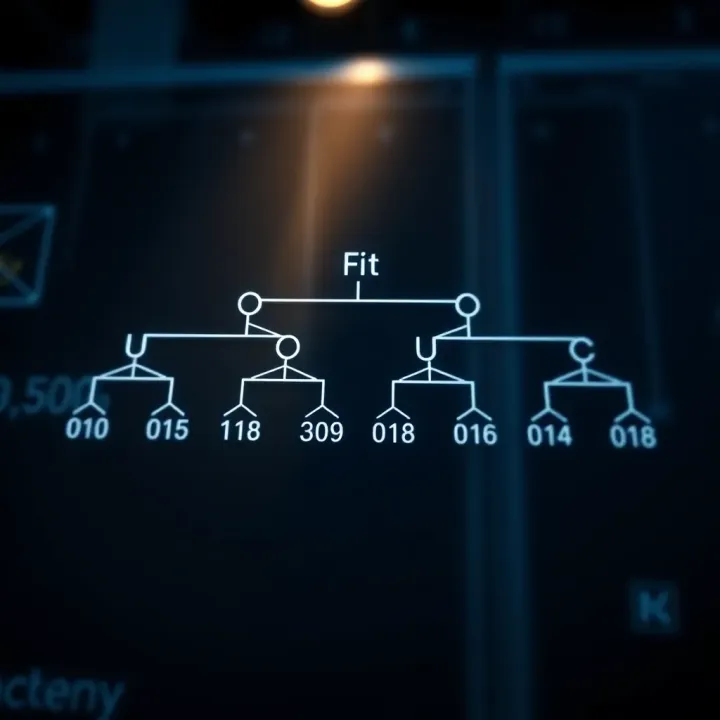
The structure of a binary tree forms the backbone of many algorithms and applications:
Expression Parsing: Compilers build expression trees to evaluate mathematical expressions.
File Systems: Operating systems organise directories and files in tree-like hierarchies.
Database Indexing: B-trees and variants index large datasets for quick access.
Binary trees also have well-defined properties such as height, depth, and leaf nodes that influence their performance in different applications. Traversal methods like in-order, pre-order, and post-order determine the sequence in which nodes are accessed.
For Indian students and developers, grasping these fundamentals opens up avenues to implement efficient algorithms and data models relevant both in academics and real-world software development.
In this article, we will explore the basics of binary trees, their common types, traversal techniques, and practical coding advice tailored for an Indian audience.
Understanding this foundational topic early will save you time and effort later, whether it is for cracking placements or developing scalable applications.
Understanding the basics of binary tree structure is essential for anyone diving into data structures and algorithms. A binary tree is a hierarchical model used to organise data efficiently, making tasks like searching and sorting faster and more structured.
A binary tree consists of nodes connected by edges. Each node holds data and can link to at most two child nodes, often referred to as the left and right child. The edges are simply the connections between these nodes. For instance, imagine a family tree where each person (node) connects to up to two children (nodes), and the lines connecting them represent edges. This structure helps in organising data that naturally follows a hierarchy, such as folder systems or mathematical expressions.
In a binary tree, each node (except the root) has exactly one parent. The nodes directly connected below a node are its children, and nodes sharing the same parent are siblings. This relationship is crucial for navigating the tree. For example, in a decision-making process, a parent node could represent a question, and its children represent possible answers, making traversal logical and intuitive.
The root node is the topmost node, the starting point of the tree. It has no parent. Leaf nodes are those without any children, marking the end of a path. In practical terms, consider a directory structure on your computer — the root is the main drive, while files without subfolders are leaf nodes. Understanding this helps in tasks like traversing file systems or evaluating expressions.
Binary trees organise data so it can be accessed quickly. Instead of searching through a list sequentially, a binary tree divides the dataset at each step, which reduces the time needed to find a specific item. Take phone directories for example; organising contacts using binary trees allows you to get to a name faster than scanning the entire list.
Using a binary tree can significantly speed up search and insertion compared to linear structures. Typically, these operations take logarithmic time, meaning even a large database with millions of entries can be searched efficiently. This is why databases and searching algorithms often use binary trees or their variants, ensuring quick responses even under heavy load.
Binary trees balance simplicity and performance, making them a practical choice for developers and analysts working with hierarchical data or search-intensive applications.
Overall, grasping these basics lays a solid foundation for understanding more advanced tree types and their uses in real-world programming scenarios, including those relevant to Indian tech ecosystems and educational contexts.

Understanding different types of binary trees helps in selecting the right structure for specific tasks. Each variant offers different benefits in terms of memory usage, speed of operations, and ease of implementation. Knowing these can improve how you organise data or implement algorithms in programming.
A full binary tree is one where every node has either zero or two children. There are no nodes with only one child. This structure is simple and predictable, which makes it useful for algorithms expecting balanced shapes but without strict height control. For example, full binary trees are often used in heap data structures where every parent has exactly two children unless it is a leaf.
A complete binary tree differs slightly; it requires all levels, except possibly the last, to be completely filled. Nodes are added from left to right. This ensures the tree is as compact as possible, minimizing wasted spaces and enabling efficient storage, especially in array-based implementations. This property makes complete binary trees popular in priority queues because they allow O(log n) operations with straightforward parent-child index calculations.
A perfect binary tree is both full and complete, meaning all leaf nodes are at the same depth, and every parent has two children. This ideal form guarantees minimal height, which optimises search and insertion times. Such trees are rare in real-world use but serve as benchmarks for tree efficiency.
Balanced binary trees maintain a condition that the difference in height between left and right subtrees at any node is constrained, often by one. This balance prevents the tree from becoming skewed, which would degrade performance to linear time for certain operations. Balanced trees like AVL trees or Red-Black trees are commonly employed in databases and file systems to ensure fast access and updates.
Binary Search Trees (BSTs) follow a strict ordering rule: for any node, all values in its left subtree are less than that node's value, and all values in its right subtree are greater. This ordering allows quick decision-making during searches, insertions, and deletions.
Because of this structure, BSTs support fast searching and sorting. On average, searching takes O(log n) time, much faster than a linear search through unsorted data. However, unbalanced BSTs can degrade to O(n) if nodes insert in sorted order; thus, self-balancing BSTs are preferred for consistent performance in practical applications like indexing in search engines or database systems.
Choosing the right binary tree type significantly impacts the efficiency of your algorithms. Full, complete, perfect, and balanced trees each fit different scenarios and applications.
Full trees have nodes with zero or two children.
Complete trees fill every level from left to right, except possibly the last.
Perfect trees are both full and complete, optimising height.
Balanced trees maintain height difference constraints to avoid skew.
Binary Search Trees apply strict order rules to enable fast searching and sorting.
Knowing these helps Indian developers and students pick the right binary tree for their projects, ensuring better performance and resource use in coding tasks or data management.
Traversing a binary tree means visiting each node in a specific order to process or retrieve information effectively. This is essential for tasks like searching, sorting, or modifying data stored in the tree. Different traversal methods serve distinct purposes depending on how the data needs to be accessed or manipulated. For example, some applications require nodes to be visited in ascending order, while others need nodes processed before their children. Understanding traversal techniques is key for students and developers to implement efficient algorithms and handle binary trees properly.
Depth-first traversal explores as far as possible along each branch before backtracking. It consists mainly of three techniques: inorder, preorder, and postorder traversal.
Inorder traversal visits the left subtree first, then the current node, and finally the right subtree. This method is especially useful in binary search trees (BSTs) because it visits nodes in ascending order. For instance, if you have a BST representing stock prices collected over time, inorder traversal will give you prices sorted from the lowest to highest, making it easier to analyse trends or perform range queries.
Preorder traversal visits the current node before its left and right subtrees. This technique is beneficial when you want to create a copy of the tree or save its structure to a file because it records the root first followed by child nodes. In practical programming, preorder traversal helps when constructing expression trees for compilers or calculators, ensuring the operator or function is recorded before its operands.
Postorder traversal visits the left and right subtrees first and the current node last. It suits use cases requiring nodes to be processed after their descendants, such as deleting a tree or evaluating expression trees. For example, in evaluating an arithmetic expression stored as a binary tree, postorder traversal processes operands before operators, which matches the calculation order.
Breadth-first traversal, also known as level order traversal, visits nodes level by level starting from the root. It moves horizontally across the tree layers before going deeper. This method is useful in scenarios like networking or database indexing where nodes at a particular depth need to be processed together.
For example, consider a mobile app that suggests friends based on social connections mapped as a binary tree. Level order traversal helps identify all immediate friends before moving to friends of friends, facilitating features like mutual connections. In coding interviews, level order traversal often tests knowledge of queue data structures and tree breadth handling.
Traversal techniques provide different pathways to process binary trees effectively. Choosing the right method depends on the specific task, whether it's accessing sorted data, copying tree structures, or evaluating expressions.
Binary trees find their place in numerous practical scenarios, proving essential for efficient data management and algorithmic operations. Their simple yet versatile structure helps programmers and analysts organise and process data efficiently, especially in fields like computer science and technology.
Expression parsing involves analysing and evaluating mathematical or logical expressions. Binary trees serve as a natural representation here, where each node corresponds to an operator or operand. For instance, in an arithmetic expression like (3 + 5) * 2, the binary tree stores * at the root, with + and 2 as its children. This structure enables computers to evaluate expressions systematically by traversing the tree in specific orders, improving the clarity and speed of interpreting complex formulas.
Searching algorithms heavily rely on binary trees, especially the variant known as binary search trees (BST). These trees maintain data in a sorted order, allowing quick lookup, insertion, and deletion operations. For example, if you're maintaining a database of stock prices or client records, a BST can swiftly help find a particular entry without scanning the entire dataset. This efficiency is vital when working with large volumes of data, such as financial time series or user information on trading platforms.
Use in databases and indexing is a critical application of binary trees. Indian IT companies managing vast databases use them to speed up query responses. Indexing a large dataset, like customer details on e-commerce platforms such as Flipkart or BigBasket, often involves tree structures like B-Trees (a generalisation of binary trees). This approach reduces search time drastically, ensuring customers get faster product searches or order tracking updates.
Role in networking protocols can also be linked to binary trees. Various routing algorithms and protocol implementations in the Indian telecom sector use tree-like data structures to manage connections and data packets efficiently. For instance, routing tables can be optimised using binary trees to quickly decide the best path for data transfer, which is crucial given India's massive mobile user base and the rise of internet services in rural areas.
Binary trees, though simple in design, contribute significantly to the backbone of many digital applications used daily across India—from parsing expressions in software development to managing large databases and improving network efficiency.
In these ways, understanding and utilising binary trees effectively helps developers and analysts build faster, smarter applications tailored to India's dynamic tech landscape.
Implementing a binary tree efficiently requires careful consideration of the data structures used for nodes and how memory is managed. These choices directly affect the tree’s performance and reliability, especially when dealing with large datasets or constrained environments, such as many Indian institutions or startups working with low-cost hardware.
Class-based nodes offer an intuitive way to represent each element in the binary tree. By defining a node as a class, you encapsulate key components like the data value and references (or pointers) to left and right children. This encapsulation enables easier debugging and maintenance, especially in object-oriented languages like Java or Python, popular among Indian developers. For example, a student implementing a binary search tree (BST) for a college project benefits from the clarity and organisation provided by class-based nodes.
Using classes also helps when extending node features later, such as adding parent pointers or additional metadata like height for balanced trees. Such flexibility proves useful in complex applications like expression parsing or dynamic databases.
Pointer or reference management is critical to ensure efficient tree navigation and modification. In languages like C or C++, pointers explicitly link nodes, requiring careful allocation and deallocation to avoid memory leaks. For instance, an Indian startup working with embedded systems must handle pointers cautiously, as improper use could cause performance issues on limited hardware.
In contrast, languages like Java or Python use references handled by garbage collection, simplifying memory management but potentially affecting performance. Understanding how your chosen language manages references can help optimise traversal or node insertion, which is handy when designing apps that must run smoothly on a range of devices, from flagship smartphones to affordable models common in India.
Optimising for resource constraints means writing code that runs well on devices with limited RAM and processing power. Since many users in India access applications through budget smartphones or older computers, it’s essential to keep the binary tree’s implementation lightweight. For example, avoiding unnecessary object creation or recursive calls reduces memory overhead and improves speed.
Offering simplified tree structures can also help—for instance, limiting the depth of trees or trimming branches dynamically during runtime may prevent performance bottlenecks. Indian developers often juggle these constraints in mobile app development, making optimisation not just beneficial but sometimes a necessity.
Approach for low-end devices and varied internet speeds must also address how data structures interact with network-dependent tasks. If your binary tree is part of a search feature in an app like an e-commerce marketplace or educational platform, ensuring fast local processing reduces dependence on slow or unreliable internet.
Offline-friendly data caching and minimal data transfer can be combined with efficient tree traversal algorithms to keep app responsiveness high. Such practices improve user experience in tier-2 and tier-3 cities, where connectivity issues persist. Including these considerations elevates your binary tree coding beyond theory into real-world readiness.
When implementing binary trees, striking a balance between clean code, performance, and resource use is key—especially in the diverse Indian tech landscape where device capabilities and network quality vary widely.
Use class-based nodes to organize tree elements cleanly and allow for future enhancements.
Manage pointers or references as per the programming language and device limits.
Optimise memory usage to suit low-end hardware prevalent in the Indian market.
Design algorithms mindful of connectivity challenges to improve local responsiveness.
By following these tips and best practices, you can develop binary tree implementations that are not just technically sound but practical and resilient across India's unique technological environment.
Learn about the Optimal Binary Search Tree algorithm in DAA 📚: understand its construction, dynamic programming approach, real-life examples, and time complexity.

Explore how Binary Search Trees work 🔍 Learn about insertion, search, deletion, and traversal with practical tips for efficient data handling in programming.

Explore BST operations like insert, search, delete, and traversal methods 📚. Learn how to keep trees balanced for faster data access and efficiency 🌳💡.

Explore how to find the max height of a binary tree 🌳, its importance in CS, and methods to calculate it with examples and algorithms. Learn tree basics!
Based on 6 reviews