

Level Order Traversal of a Binary Tree Explained
📚 Explore how level order traversal of a binary tree works, its importance, practical uses, code examples, comparisons, & common pitfalls to avoid.
Edited By
Henry Lawson
Binary tree traversal is a key concept in data structures that helps you explore or process each node of a binary tree systematically. Since binary trees form the backbone of many computing problems, especially those involving hierarchical data, gaining a clear grasp of traversal techniques is essential for beginners, analysts, and even investors who use algorithmic trading models involving trees.
Traversal defines the order in which nodes get visited and processed, affecting how data is accessed, modified, or retrieved from the tree. There are mainly four traversal methods:
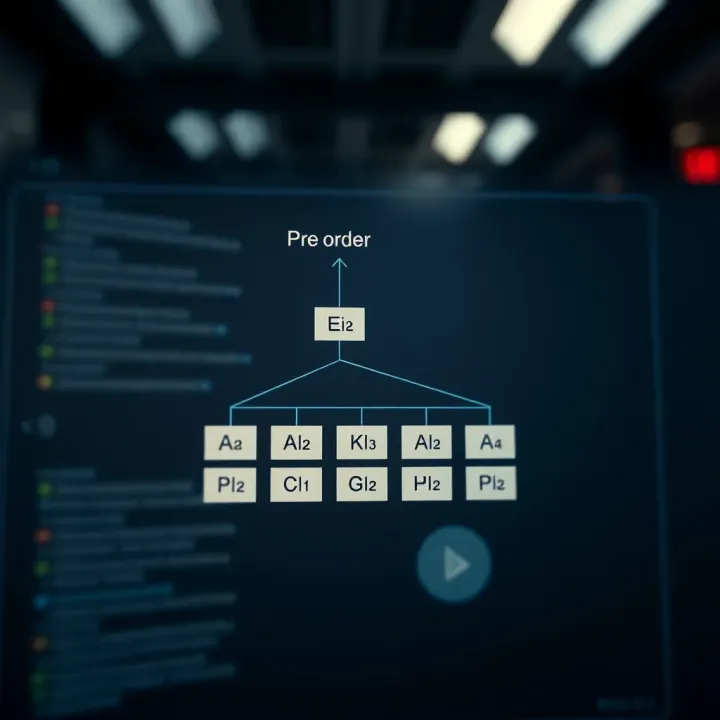
Preorder traversal: Visit the root node first, then recursively traverse the left and right subtrees.
Inorder traversal: Traverse the left subtree first, visit the root node, then traverse the right subtree.
Postorder traversal: Traverse left and right subtrees first, then visit the root node.
Level order traversal: Visit nodes level by level from top to bottom, usually implemented using a queue.
Knowing when to use each traversal depends on your goal. For instance, inorder traversal is widely used to retrieve binary search tree elements in sorted order, while level order traversal works well for breadth-wise operations.
Traversal implementations rely on two main approaches: recursive and iterative. Recursive methods use function calls to dive deep until all nodes are visited, which is easier to write but can hit stack limits with very large trees. Iterative methods, often utilising stacks for depth-first traversals or queues for breadth-first, save on memory and give better control for applications requiring tail-recursion avoidance.
In practical scenarios, binary tree traversal appears in database indexing, parsing expressions, file system navigation, and decision-making algorithms. For example, compilers use postorder traversal to evaluate expression trees to generate correct computation sequences. Similarly, traders utilising algorithmic strategies might use traversal to navigate decision trees quickly and efficiently.
Understanding these traversal techniques gives you a solid foundation to handle tree-based data and build efficient algorithms, crucial for technical interview preparation, software development, or even financial modelling that leans on data structures.
Overall, traversal is not just a technical concept but a practical tool for handling complex data systematically and efficiently.
Getting a clear grasp of binary trees and traversal methods is essential for anyone working with data structures, especially if you want to understand how data is organised and accessed efficiently. Binary trees underpin many key algorithms used in databases, file systems, and search engines. Without understanding these basics, you’ll struggle to follow more advanced topics like traversal techniques or optimisation strategies later.
A binary tree is a hierarchical data structure where each node has at most two children, usually called the left and right child. This simple structure allows data to be organised in a way that supports fast searching, insertion, and deletion. For instance, binary search trees arrange data so that all left descendants contain smaller values, and right descendants contain larger ones, making lookups much quicker than scanning through a list.
This setup becomes handy in practical cases such as managing hierarchical data in a company, like employees under different managers, or organising a sorted list for quick retrieval.
Understanding terms like root, parent, child, leaf, and height is important to work fluently with binary trees. The root is the topmost node, from which all others descend. Leaves are nodes without children, often representing the end points in data paths. Height refers to the longest path from the root to a leaf, which affects the performance of traversal and other operations.
Knowing these terms helps when describing algorithms clearly or debugging tree-related problems. For example, the height of a tree directly impacts the time it takes to search for an element.
Tree traversal means visiting every node in the tree exactly once, to either inspect, modify, or collect data. Traversal is the backbone of many data processing tasks because it defines the order in which the tree’s information is accessed. Say you want to print out all values stored in a tree or check if a certain value exists—you’ll need a traversal method.
Without a systematic approach, you might miss nodes or waste time visiting the same parts repeatedly. Traversal ensures you cover the entire structure methodically.
Broadly, traversal strategies fall into two categories: depth-first and breadth-first. Depth-first methods—like preorder, inorder, and postorder—go deep along one branch before backtracking. In contrast, breadth-first traversal, also called level order traversal, processes nodes level by level.
Each strategy suits different problems. For example, inorder traversal works well to output sorted data from binary search trees, while level order traversal is often used in shortest path algorithms or serialising trees for storage.
Choosing the right traversal technique depends on what you need to do with the data and the structure of the tree itself. Understanding these basics sets a strong foundation for exploring specific algorithms and their real-world applications.
Depth-first traversal (DFT) techniques are essential when dealing with binary trees because they explore nodes by going deep into each branch before backtracking. This approach lets you access the structure of a tree in useful sequences depending on the specific traversal method used. For investors or traders dealing with algorithmic data, understanding DFT provides a way to process hierarchical information efficiently, such as parsing financial expression trees or analysing decision structures.
Traversal order explanation: In preorder traversal, nodes are visited in the sequence: root, left subtree, then right subtree. This means you first process the current node itself, then explore its left child, followed by the right child. This top-down approach is practical when you want to copy a tree or generate a prefix expression in compiler design.
Example and tree walking: Consider a simple tree with root A, left child B, and right child C. Preorder visits A first, then moves to B and finally to C. Walking through the tree this way helps in scenarios like generating a hierarchical list or printing the structure as it appears from the top.
Use cases in real-world applications: Preorder traversal finds use in tasks such as creating a snapshot of the file system where directories (nodes) need to be handled before their contents (children). It's also crucial in expression tree evaluations where operators come before operands, enabling prefix notations used in calculators or programming languages.
Traversal sequence description: Inorder traversal visits the left subtree first, then the root node, and finally the right subtree. This left-root-right sequence hits every node in a binary tree, allowing for a natural in-order processing of data.
How it produces sorted output in binary search trees: A binary search tree (BST) keeps smaller values at the left and larger ones at the right. Inorder traversal then naturally visits nodes in ascending order. This makes it very useful for operations like extracting sorted data without additional sorting steps.
Practical applications: Beyond sorting, inorder traversal plays a key role in database indexing and retrieval where data needs to be processed in a sorted order. It also helps in constructing balanced trees by sequentially visiting nodes and reorganising them to maintain efficiency.
Order of node processing: Postorder traversal processes nodes in the order: left subtree, right subtree, and then the root. This means you visit all children before the parent node.
Example walkthrough: Take a tree with nodes A (root), B (left), and C (right). Postorder visits B first, then C, and last A. This ensures that child nodes are fully handled before moving up the tree.
Relevance in deletion operations and syntax parsing: Postorder traversal is vital when deleting nodes in a tree, as it ensures that children are removed before the parent node, preventing dangling references. In compilers, it supports syntax parsing where operations must be resolved after their operands have been processed, ideal for evaluating postfix expressions.
Mastery of depth-first traversal techniques like preorder, inorder, and postorder equips you with the tools to handle diverse problems in data processing, algorithm design, and even financial computations requiring tree-based logic.
Level order traversal stands apart from other binary tree operations as it processes nodes level by level, starting from the root and moving downwards. This method is especially valuable in scenarios where you need to access all nodes closest to the root before moving deeper. For traders or analysts handling hierarchical data, such as organisation charts or financial portfolios, level order traversal helps in capturing broad, immediate-level information before diving into specifics.
At its core, breadth-first traversal explores all nodes at the current depth before moving on to the next. Imagine standing at the top floor of a building and inspecting every room on that floor before using the stairs to go down to the next level. This approach contrasts with depth-first traversal, which dives down one path all the way to a leaf before backtracking.
Breadth-first traversal’s pattern makes it suitable for scenarios requiring layer-based processing. For example, in network routing or social media connections, information from immediate neighbours is processed first to reflect real-world proximity. This traversal is systematic and can better handle wide-spread structures compared to depth-first variants, which may miss nearby nodes for longer periods.
Depth-first methods like preorder, inorder, and postorder go deep into one branch before exploring others. While they are memory-efficient for narrow or balanced trees, they may not suit cases where level-wise data is crucial. In contrast, breadth-first traversal ensures all siblings at a level are visited before going deeper, providing a more uniform exploration.
For example, in financial market graphs connecting various assets, breadth-first traversal quickly identifies all assets connected at one degree of separation before moving further. Depth-first techniques might unnecessarily dwell on a single asset’s chain, missing out on others at the same level.
Queues provide the natural data structure for level order traversal. Nodes are enqueued as they appear, ensuring that the oldest entered node (closest in the traversal sequence) is processed first. This FIFO (First In, First Out) behaviour aligns perfectly with the level order approach.
Using a queue does more than maintain order; it also helps track nodes whose children are yet to be explored. This dynamic makes implementing level order traversal efficient and straightforward, especially in programming languages like Java or Python with built-in queue libraries.
Consider a binary tree where the root node is 10, with two children 5 and 15. The queue initially contains the root. You dequeue 10, process it, and then enqueue its children 5 and 15. Next, 5 is dequeued and processed, followed by its children if any, before moving on to 15.
This systematic enqueue-dequeue cycle continues until the queue is empty, ensuring every node is visited level-wise. This example shows how queues maintain the traversal order naturally, making level order traversal both predictable and easy to implement.
Level order traversal’s strength lies in its ability to manage nodes level by level, making it invaluable for applications demanding equal priority access to all nodes at a given depth.
By understanding the working of breadth-first traversal and its queue-based implementation, beginners, investors, and analysts can navigate binary tree data more effectively, whether for coding problems or analysing layered datasets.
Tree traversal is fundamental to working with binary trees, and choosing between recursive and iterative methods can affect both readability and performance of your code. Recursive approaches align closely with the natural hierarchy of trees, while iterative methods often improve efficiency and control. Understanding both helps you pick the right technique depending on your application and resource constraints.
Recursion simplifies tree traversal by breaking down the task into smaller subproblems—processing a node, then its left and right subtrees in a self-similar manner. For example, a recursive inorder traversal simply calls itself on the left child, visits the node, then proceeds to the right child. This mirrors the logical structure of binary trees, making the code concise and easy to grasp.
That said, recursion relies heavily on the system call stack to keep track of nodes, which can lead to limitations. For deep or unbalanced trees, recursive calls may cause stack overflow errors. Also, excessive recursion increases memory use as each call pushes a new frame onto the stack. While convenient for moderate tree sizes, recursion might not scale well for very large or skewed trees.
Iterative traversal methods tackle the stack issue by explicitly managing data structures such as stacks or queues, avoiding the system call stack altogether. For preorder, inorder, and postorder traversals, iterative algorithms employ stacks to keep track of nodes to be visited, mimicking recursion but offering more control.
Queues are primarily used in level order (breadth-first) traversal but can assist in iterative depth-first traversals as well. These data structures make the traversal process transparent and often more memory-efficient. For instance, iterative inorder traversal pushes nodes onto a stack as it moves left, then processes them, gradually covering the whole tree.
Choosing iteration over recursion generally makes sense when working with large datasets or environments with limited stack size. Iterative methods avoid the risk of stack overflow and often run faster because function call overhead is reduced. However, they require more coding effort and a good understanding of the underlying data structures.
Iterative traversals offer greater stability and performance for large or complex trees, while recursive approaches excel in clarity and simplicity for smaller or well-balanced trees.
In practice, balancing ease of implementation with performance needs will guide whether recursion or iteration fits your binary tree traversal tasks best.
Binary tree traversal techniques have wide-reaching applications in computer science, especially where hierarchical data structures come into play. Understanding how to traverse efficiently not only helps in manipulating data but also in optimising performance for large datasets. This section explores some practical use cases followed by key performance considerations.
Expression tree evaluation involves processing binary trees where leaves represent operands and internal nodes represent operators. By traversing this tree—usually in postorder—you evaluate expressions by calculating sub-expressions before applying operators. This approach is crucial in calculators, compilers, and interpreters where expressions must be evaluated correctly and quickly. For example, an expression like (3 + 2) * 5 is parsed into a tree and evaluated systematically to give the correct result.
Tree-based searching and sorting rely heavily on inorder traversal, especially when working with binary search trees (BST). Inorder traversal visits nodes in ascending order of their keys, making it ideal for producing sorted sequences from BSTs. This property supports efficient searching, insertion, and deletion in applications like symbol tables, dictionaries, and priority queues used in many trading algorithms and data retrieval systems.
File system and database indexing often use tree structures such as B-trees or binary trees to organise data. Traversal methods enable operations like scanning files, fetching records, or managing indexes efficiently. For instance, to list all files in a directory or fetch database records in sorted order, level order or inorder traversal is applied. This leads to faster data access and reduces query response times in real-world database systems.
Time and space complexity analysis plays a vital role in deciding which traversal method to use. Most tree traversals, whether preorder, inorder, postorder or level order, generally run in O(n) time since every node is visited once. However, space complexity can vary: recursive methods use stack space proportional to the tree height, which, in unbalanced trees, can become linear. Iterative methods typically maintain explicit stacks or queues, impacting memory based on tree breadth or depth.
Tail recursion and iterative enhancements help improve traversal efficiency by preventing stack overflow and lowering memory overhead. Tail recursion optimises recursive calls where the recursive call is the last operation, allowing some compilers to optimise the call stack. When tail recursion isn’t possible, iterative solutions using stacks or queues are preferred. For example, iterative inorder traversal avoids deep recursion delays, which is helpful in constrained environments like mobile devices or embedded systems.
Handling large trees efficiently requires methods that reduce memory consumption and enable partial traversal. Techniques like threaded binary trees allow traversal without additional stacks by using unused pointers. Also, iterative level order traversal helps process trees layer by layer, which suits applications dealing with streaming data or real-time updates. These optimisations ensure that even extremely large data sets, such as social network graphs or massive file systems, can be navigated smoothly.
Optimising traversal methods not only improves speed but also resource use, making binary trees practical even in high-demand, large-scale applications.
In sum, binary tree traversal isn't just a theoretical concept but a critical tool for many real-world computing challenges. Choosing the right traversal method and optimising its implementation can make a significant difference in software performance and functionality.
📚 Explore how level order traversal of a binary tree works, its importance, practical uses, code examples, comparisons, & common pitfalls to avoid.

Learn about the Optimal Binary Search Tree algorithm in DAA 📚: understand its construction, dynamic programming approach, real-life examples, and time complexity.

Explore how Binary Search Trees work 🔍 Learn about insertion, search, deletion, and traversal with practical tips for efficient data handling in programming.

Explore BST operations like insert, search, delete, and traversal methods 📚. Learn how to keep trees balanced for faster data access and efficiency 🌳💡.
Based on 7 reviews