

Understanding Lowest Common Ancestor in Binary Trees
Explore how to find the lowest common ancestor in binary trees 🧑💻, compare algorithms ⚖️, and see practical examples for learners and pros in India 🇮🇳.
Edited By
Edward Collins
When we dive into binary trees, one question pops up quite often: how can we find the Lowest Common Ancestor (LCA) of two nodes? It's not just an academic curiosity; this concept shows up in plenty of real-world tech scenarios, like network routing, version control, and even database query optimization. Getting a grip on how to identify the LCA saves you from reinventing the wheel each time you deal with hierarchical data.
This article aims to break down the idea of the Lowest Common Ancestor in a straightforward way. We’ll cover what it means, why it matters, and practical ways to find it through different methods. We’ll look at recursive solutions you might already know, but also iterative approaches that can sometimes be more efficient or easier to implement depending on your tree size and structure.

Whether you’re just starting out in coding, analyzing data structures, or looking to sharpen your problem-solving habits, understanding LCA will add a useful tool to your arsenal. It’s a concept that opens doors to better algorithm design and handling complex hierarchical relationships neatly and efficiently.
The Lowest Common Ancestor isn't just a tree problem — it's a blueprint for organizing connections and understanding relationships within data.
By the end of this guide, you should have a clear path to implement and use LCA in your projects. You’ll see why it’s a popular problem in coding interviews and technical discussions and how mastering it gives you an edge in dealing with hierarchical data structures effectively.
When dealing with binary trees in programming and computer science, the concept of the Lowest Common Ancestor (LCA) plays a key role in various problems. LCA refers to the deepest node in a binary tree that is a common ancestor to two given nodes. Understanding this concept helps in solving questions related to tree traversal, relationship queries, and optimizing certain operations.
Consider a family tree scenario where you want to find the closest common ancestor for two relatives. In computational terms, this is similar to identifying a node in a tree data structure from which both nodes descend. This practical perspective shows why learning about LCA goes beyond theory—it directly influences how efficiently we can retrieve hierarchical information.
Moreover, knowing how to find the LCA can simplify complex problems in networking, databases, and biological data analysis. For example, in file systems, determining the lowest common directory helps optimize file searches. This article will walk you through the nuts and bolts of LCA, providing clear definitions and practical reasons why this concept matters.
The Lowest Common Ancestor of two nodes in a binary tree is the node furthest from the root that is an ancestor to both nodes. To break it down, you can think of it as the "closest shared parent" in the tree structure. If you visualize a family tree, LCA is equivalent to the most recent common forebear shared by two descendants.
For instance, imagine a binary tree where node 3 and node 9 are leaves. Their LCA might be node 5 if node 5 is the lowest node having node 3 and node 9 in its subtrees. This node acts as a junction point from which paths to both nodes diverge.
Understanding the LCA requires clarity on what ancestor means—a node is an ancestor if it lies on the path from the root to a given node. The "lowest" emphasizes that among all common ancestors, we pick the one closest to the nodes in question.
Locating the LCA helps solve many practical problems in computer science, especially because binary trees often represent hierarchical or nested data. For starters, it helps in efficient navigation and retrieval of nodes when querying relationships or dependencies.
Take network routing as an example: finding the LCA of two network nodes can identify the closest common switch or router they connect through, which aids in optimizing communication paths. Similarly, file systems use similar logic to quickly find shared directories when comparing file locations.
From an algorithmic viewpoint, being able to swiftly identify the LCA reduces overhead and improves the speed of operations like searching, updating, or restructuring tree-based data. Given how often binary trees appear in coding problems and real-world applications, mastering LCA contributes directly to writing faster, cleaner, and more reliable code.
Remember, understanding LCA is not just about a technical definition but about applying the concept where relationships within hierarchical data matter the most.
Grasping the concept of binary trees is a must before diving into the Lowest Common Ancestor (LCA). Binary trees form the backbone of many data structures and algorithms, especially in areas like parsing expressions, organizing databases, and managing hierarchical data. When you understand a binary tree’s organization, it becomes easier to pinpoint relationships such as common ancestors.
Imagine working with an organizational chart. Each manager might oversee two direct reports, no more. This hierarchy mirrors a binary tree's structure, where each node can have up to two children. Such real-life analogies make it clear why binary trees matter.
At its core, a binary tree is a set of connected nodes. Each node has three components:
Value: The data the node holds.
Left child: Points to the left subtree.
Right child: Points to the right subtree.
The tree starts from a root node and branches out. Key properties help us understand the tree better:
Height: The length of the longest path from the root to a leaf.
Depth: Distance from the root to a particular node.
Leaf nodes: Nodes without children.
These attributes give us tools to navigate and work with trees efficiently. For example, when finding the LCA, knowing the heights or depths can guide the process.
A full binary tree is a tree where every node has either zero or two children—no nodes with just one child. Think of a tournament bracket where each match has exactly two participants or none (final winner). This structure simplifies finding the LCA because each step down the tree’s branches involves clear decisions – no ambiguous single-child paths.
The importance? With full binary trees, traversal algorithms become predictable and reliable, reducing the chances of logic errors in identifying common ancestors.
Complete binary trees are filled on every level except possibly the last, which fills from left to right. They're often used in heap implementations.
Why does this matter for LCA? These trees maintain a compact shape, ensuring that the depth difference between nodes is minimal. This balance helps keep LCA operations efficient because nodes you compare won’t be wildly apart in depth.
As an example, picture storing tournament scores in an array—which is common with complete binary trees. Because the tree is neatly packed, computing relations like LCA becomes straightforward, since parent-child relationships reflect simple index calculations.
Binary Search Trees (BST) are a special kind of binary tree where each node’s left subtree contains values less than the node’s value, and the right subtree contains values greater.
This ordering dramatically speeds up the LCA search. Instead of exploring multiple paths blindly, you follow the value’s trail down the tree. For example, if you want to find the LCA of 10 and 20, starting at the root, if the root value is 15, you can tell:
Since 10 is less than 15, go left.
Since 20 is greater than 15, go right.
The moment paths diverge, you find the LCA.
This property means BSTs allow a much leaner approach to LCA, often halving the search space at each step, making the process faster than checking every node.
Understanding which type of binary tree you’re dealing with helps tailor search strategies for LCA and avoid unnecessary overhead in processing.
In the next sections, we’ll explore how these structures influence the algorithms used to find the Lowest Common Ancestor and walk through practical approaches based on these tree types.
When you’re dealing with binary trees, finding the Lowest Common Ancestor (LCA) is a frequent task that often pops up in coding interviews, database indexing, or network routing. Understanding the common methods to find the LCA helps you apply the right approach depending on the tree structure and constraints.
Most approaches either leverage recursion or deal with traversal iteratively, so knowing both is a must-have skill. Each method comes with trade-offs—recursive methods are often simpler to implement but might be costly in memory due to call stacks, while iterative ones can be more complex but avoid overheads.
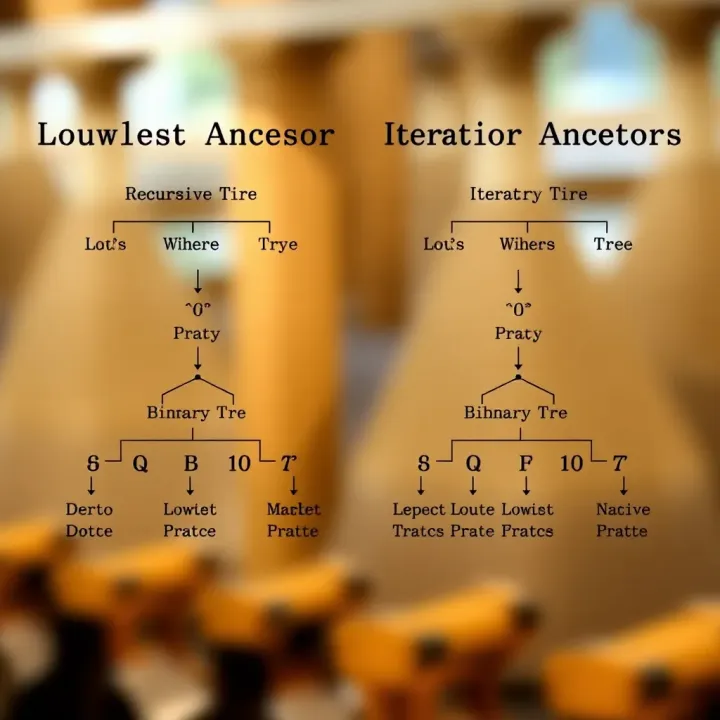
The recursive search is about exploring from the root to the leaves in search of the two target nodes and then bubbling the common ancestor back up the call stack. Imagine you’re asked to find the LCA of two employees in an organization chart tree. Starting from the CEO (root), the recursion drifts down two paths: one to find the first employee and the other to find the second. Whenever both are found in different subtrees, that node is the LCA.
This method takes advantage of depth-first search (DFS) concepts and naturally fits with binary trees. The function calls itself on left and right children and returns immediately if it hits a node matching one of the targets—or returns null if neither subtree has them.
The elegance of recursion lies in its simplicity and direct correlation with the tree’s structure, making it easier to debug and understand.
A sturdy base case prevents infinite loops and ensures that the recursion completes correctly. The fundamental base cases are:
If the current node is null, return null (meaning no LCA found here).
If the current node equals one of the target nodes, return the current node.
Once the base conditions are met, the function recursively calls itself on the left and right subtrees. When both calls return non-null nodes, it means both targets are found in different branches, so the current node is the LCA. If one side returns null, the ancestor lies on the other side.
This straightforward logic also helps detect cases where one or both nodes are not present in the tree, as null results propagate upward.
In some trees, each node has a pointer to its parent. This little extra info makes iterative LCA finding quite efficient. You can collect all ancestors of one node in a set, then move up the other node’s ancestors step by step until you hit one in the set—that’s your LCA.
Think of tracking two family lines back to a common grandparent. This approach avoids recursion and is easy to implement but requires you to store or maintain parent pointers. If your tree doesn’t have this, you either preprocess the tree to add these pointers or choose another approach.
When no parent pointers exist, a stack-based iterative approach can come handy. By mimicking DFS using stacks, you traverse the tree and keep track of nodes’ parents in a dictionary or map. Once you find both target nodes, you can reconstruct their ancestor paths using the parent map and find the LCA by comparing both paths from the bottom up.
This approach is a bit more involved but useful in environments that limit recursion depth, or where you want explicit control over the traversal stack.
Efficient LCA algorithms give a big leg up in many practical applications, and mastering both recursive and iterative approaches broadens your problem-solving toolkit.
When working with the Lowest Common Ancestor (LCA) in binary trees, it’s not always as straightforward as running a single algorithm and calling it a day. Real-world data structures and applications often present variations or special scenarios that can throw a wrench in the most straightforward approaches. Understanding how to handle these nuances is important because it makes your solutions more reliable and adaptable.
Take, for example, a typical binary tree where every node has a parent pointer, versus one without it. The strategies for finding the LCA differ significantly, since in the former case, you can use parent pointers to climb up the tree, simplifying the search. In contrast, without parent pointers, you need a method that inspects subtrees carefully.
Another angle is dealing with binary search trees (BSTs) compared to general binary trees. The BST property often allows quicker shortcuts owing to the ordering of values, which can avoid unnecessary traversals. Lastly, there’s the challenge of nodes that just do not exist in the tree, something that can easily cause errors if not checked beforehand.
In the below sections, we’ll look at these special cases more closely, discussing their particular challenges and advantages.
Binary Search Trees offer a neat edge when it comes to finding the LCA because of their inherent ordering property. By definition, for any node, all values in the left subtree are smaller, and all in the right subtree are greater. This single fact slashes down the search space drastically.
Imagine trying to find the LCA of nodes with values 10 and 30 in a BST: if you start at the root node with value 20, you can immediately tell that 10 lies in the left and 30 lies in the right. So, the root itself is the LCA — no further deep search needed. This property means you can find the LCA in a BST by just comparing node values and navigating either left or right, which is a neat shortcut.
This advantage makes BSTs particularly appealing for applications dealing with sorted data, such as indexing and search operations.
When a binary tree doesn’t maintain parent links, things get trickier. You can’t simply climb upwards to ancestors from a given node; your approach must dig into subtrees to find both nodes and their common ancestor.
Typically, this involves a recursive approach that explores each node's left and right children. The tricky part is keeping track of which subtrees contain the nodes you're looking for and figuring out where they split to find the ancestor. This method can be more resource-heavy and sometimes complex to implement correctly, especially under tight memory or runtime constraints.
For example, a careless implementation might return a false LCA if one of the sought nodes doesn’t exist in the tree—a problem avoided in trees with parent pointers since you can verify existence easily.
It’s easy to assume the nodes whose LCA you want will always be present. But in practice, missing nodes cause headaches if your algorithm doesn’t check their existence properly.
Good practice is to first confirm both nodes are in the tree before attempting to find their LCA. This pre-check can be another simple traversal that looks for the target values.
Failing to do so might lead your algorithm to return incorrect ancestors or null values, confusing your program or producing misleading results. For instance, if you're using a recursive method without checks, the function might end up returning an ancestor of just one node or none at all.
Remember: Always validate input nodes exist in the tree before processing the LCA. It saves from logical errors and unexpected results.
One straightforward check could be:
python
def exists(root, key): if not root: return False if root.val == key: return True return exists(root.left, key) or exists(root.right, key)
In the end, handling these special cases isn't just about coding neatness — it’s about building robust software that works under all expected (and unexpected) scenarios. This diligence turns an average program into one that stands up in the real world.

## Algorithm Efficiency and Complexity

When dealing with binary trees, nailing down an efficient algorithm for finding the Lowest Common Ancestor (LCA) can make all the difference, especially if you're handling large datasets or real-time operations. Algorithm efficiency touches upon how fast your algorithm runs (time complexity) and how much memory it gobbles up (space complexity). Both matter because they can impact the scalability and responsiveness of your application.

Let's take a practical perspective. Say you are working on a file system where each node is a folder or file, and you want to quickly find the common parent directory for any two given files. If your algorithm is slow, users end up waiting, and if it's clunky on memory, your app might slow down or even crash. So understanding and optimizing these complexities can lead to smoother, faster user experiences.

### Time Complexity of Common LCA Methods

Time complexity basically measures how the computation time increases as the tree size grows. For most straightforward recursive methods, the time complexity is **O(n)**, where n is the number of nodes in the binary tree. This happens because, in the worst case, the algorithm visits every node once to find the two nodes and their ancestor.

For example, if you’re using a recursive method without any parent pointers, you might traverse large parts of the tree multiple times unwittingly, especially if your nodes are deep down in opposite branches. On the other hand, in a Binary Search Tree (BST), where nodes have an order, you can squeeze more efficiency out of the algorithm — often dropping to **O(h)** time, where h is the height of the tree. That's because in BST, you can decide which subtree to explore based on node values, pruning your search space nicely.

Iterative methods that rely on parent pointers can also reach **O(n)** but sometimes perform better due to avoiding recursive overheads and better memory locality.

### Space Considerations and Optimization Tips

Space complexity is just as critical, especially when memory is tight. Recursive methods inherently take space depending on the recursion depth, which in the worst case matches the tree height **O(h)**. For skewed trees, this can be almost **O(n)**, leading to stack overflow risks.

Iterative solutions using stacks or parent pointers might add extra space overhead but avoid recursion pitfalls. For instance, a stack-based traversal usually requires **O(h)** space to keep track of nodes during tree traversal.

Here are a few quick tips to keep the space use in check:

- **Use tail recursion** where possible to help some compilers optimize stack usage.
- **Cache nodes or results** when you expect repeated LCA queries, transforming the problem with preprocessing techniques like Euler tours combined with RMQ (Range Minimum Query) to reduce query times drastically.
- **Prefer iterative over recursive** implementations if working with very deep or unbalanced trees to prevent stack overflow.

> Remember, while shaving off milliseconds might seem small, when working with large trees or many queries, these optimizations can scale up to huge performance gains.

Understanding these efficiency and complexity factors helps you choose or design the right LCA algorithm method for your particular task, whether it's for academic exercises, competitive programming, or real-world software development.

## Applications of Lowest Common Ancestor in Computing

Understanding where the Lowest Common Ancestor (LCA) fits into practical computing tasks makes the concept more than just theory. It helps solve real-world problems involving hierarchical data structures. This section dives into how LCA plays a role in network routing, systems management, and biological data analysis, illustrating its broad utility.

### Use in Network Routing and File Systems

In networking, data packets often travel across nodes arranged somewhat like a tree. Finding the LCA of two nodes can reveal the closest shared routing point, which optimizes paths and reduces latency. For example, when two devices need to communicate, the LCA identifies the nearest common router, improving efficiency in directing traffic.

File systems also rely heavily on tree structures where directories and files form hierarchical relationships. Suppose you want to find the common directory encompassing two files; the LCA points exactly to that directory. This simplifies operations such as finding relative paths or managing permissions for grouped files.

More concretely, consider a Linux file system hierarchy: if you want to find the common folder between `/home/user/documents/report.doc` and `/home/user/photos/vacation.jpg`, the LCA is `/home/user`. This helps in quickly determining shared access rights or backup targets.

### Role in Genealogy and Biological Data Structures

Genealogical trees store ancestral relationships, making LCA relevant for tracing lineage. When studying family trees, the LCA tells you the closest common ancestor of two individuals, which is essential for understanding inheritance and heritage.

In biology, phylogenetic trees map evolutionary relationships between species. Identifying the LCA of two species pinpoints the last shared ancestor, shedding light on evolutionary paths and traits. For example, finding the LCA of humans and chimpanzees explains their common origin point, aiding studies in genetics and evolutionary biology.

> The LCA's value is clear when handling any hierarchical dataset—whether that's routers and files, family trees, or species evolution. It allows programmers and researchers to pinpoint crucial intersections efficiently.

By integrating LCA into these fields, professionals benefit from faster data processing and more insightful analyses. If you’re working with any hierarchical data, familiarizing yourself with LCA is a practical step toward better data handling and algorithmic finesse.

## Implementing LCA Algorithm in Programming Languages

Implementing the Lowest Common Ancestor (LCA) algorithm in programming languages is a crucial step toward applying this concept in real-world scenarios. Whether it’s for managing hierarchical data, optimizing queries, or enhancing network models, practical implementation helps solidify understanding beyond theory.

When coding the LCA algorithm, it’s important to focus not just on correctness but also on efficiency. Different programming languages offer unique structures and tools that can either simplify or complicate the implementation process. For instance, Python’s expressive syntax makes recursive implementations straightforward, while Java’s strong typing and class-based design encourage clear modularization.

**Key considerations** include handling edge cases like missing nodes or unbalanced trees and ensuring the implementation aligns well with the chosen tree type, such as a binary search tree or a general binary tree. The actual code example demonstrates how you can traverse the tree, compare nodes, and return the LCA efficiently.

By translating the algorithm into code, learners can test their understanding using real data, tweak performance parameters, and handle practical constraints like memory and speed. This hands-on approach is invaluable, especially for investors or analysts who may work with hierarchical data structures in market modeling or decision trees.

### Sample Code in Python

Python remains a favorite language among beginners and experts alike due to its readability and concise syntax. Below is a simple recursive implementation of the LCA algorithm for a binary tree:

python
class TreeNode:
    def __init__(self, val):
        self.val = val
        self.left = None
        self.right = None


def find_lca(root, node1, node2):
    if root is None:
        return None

    if root == node1 or root == node2:
        return root

    left_lca = find_lca(root.left, node1, node2)
    right_lca = find_lca(root.right, node1, node2)

    if left_lca and right_lca:
        return root

    return left_lca if left_lca else right_lca

## Example usage
root = TreeNode(3)
root.left = TreeNode(5)
root.right = TreeNode(1)
root.left.left = TreeNode(6)
root.left.right = TreeNode(2)
root.right.left = TreeNode(0)
root.right.right = TreeNode(8)

lca = find_lca(root, root.left, root.right)
print(f"LCA Node Value: lca.val")# Output should be 3
This snippet highlights a recursive strategy where the function travels down from the root and looks for the two nodes. On encountering one of them, it returns that node. If both nodes appear in different subtrees of the current root, then the current root is the LCA.
Java users benefit from strong object-oriented structures, which can promote clean separation of concerns — making debugging and scaling easier. Here’s a typical way to implement LCA in Java:
class TreeNode
    int val;
    TreeNode left, right;

    TreeNode(int item)
        val = item;
        left = right = null;

public class BinaryTree
    TreeNode root;

    TreeNode findLCA(TreeNode node, TreeNode n1, TreeNode n2)
        if (node == null)
            return null;

        if (node == n1 || node == n2)
            return node;

        TreeNode left_lca = findLCA(node.left, n1, n2);
        TreeNode right_lca = findLCA(node.right, n1, n2);

        if (left_lca != null && right_lca != null)
            return node;

        return (left_lca != null) ? left_lca : right_lca;

    public static void main(String args[])
        BinaryTree tree = new BinaryTree();
        tree.root = new TreeNode(3);
        tree.root.left = new TreeNode(5);
        tree.root.right = new TreeNode(1);
        tree.root.left.left = new TreeNode(6);
        tree.root.left.right = new TreeNode(2);
        tree.root.right.left = new TreeNode(0);
        tree.root.right.right = new TreeNode(8);

        TreeNode lca = tree.findLCA(tree.root, tree.root.left, tree.root.right);
        System.out.println("LCA Node Value: " + lca.val);  // Output should be 3
In this example, the findLCA method works similarly to the Python version, recursively checking each subtree for the presence of the target nodes. It makes use of Java's strong typing to keep track of node references clearly.
These implementations show how recursive thinking around the tree structure lets you efficiently locate the lowest common ancestor without extra memory for parent pointers.
By understanding and experimenting with these snippets, one can tailor the LCA algorithm to specific applications, whether that’s optimizing financial data structures or simplifying complex decision paths.
Getting the Lowest Common Ancestor (LCA) wrong can lead to heaps of confusion and bugs, especially if you’re knee-deep in a coding interview or working on tree-related algorithms. These mistakes often stem from not paying enough attention to base cases or edge scenarios, which are the usual suspects when recursive algorithms misbehave.
Understanding these issues can save you from hours of debugging headaches and improve your code's reliability and efficiency. Let’s break down some common blunders and practical ways to dodge them.
A strong recursive method hinges on proper base cases — they’re like the rules of the game that keep everything running smoothly. When these cases aren’t well defined, your recursive calls might end up in an endless loop or return wrong results.
For example, when finding the LCA in a binary tree, a common base case is checking if the current node is null or matches one of the nodes you're finding the ancestor for. Skipping this check or mixing it up means your function might overlook valid ancestors or crash due to a null pointer error.
Here’s a quick illustration:
python def find_lca(root, n1, n2): if root is None: return None# base case: no node here if root.val == n1 or root.val == n2: return root# base case: found one of the nodes left = find_lca(root.left, n1, n2) right = find_lca(root.right, n1, n2) if left and right: return root# nodes found in different subtrees return left if left else right
Notice if you leave out the base cases, your function might recurse unnecessarily or return something incorrect.

### Errors with Edge Cases like Missing Nodes

Another frequent pitfall happens when one or both of the target nodes aren’t actually in the tree. Many LCA implementations assume both nodes exist, which is not always true in real-world situations. If your code doesn't check for this, it may return a node that’s not actually the ancestor or cause null errors downstream.

For example, if you're looking for the LCA of nodes 5 and 9 but 9 doesn't exist in the tree, the function might still return 5 or some other node as the 'ancestor.' That’s misleading and could throw off your program’s logic.

To handle this, incorporate validation that confirms both nodes are part of the tree before concluding the LCA:

- Traverse the tree once to check presence of both nodes.
- Proceed with LCA only if both are found.

This extra step ensures your function’s output is meaningful and avoids silent failures.

> When writing your LCA algorithm, never assume the inputs are perfect. Expect the unexpected, especially missing nodes, and code defensively.

By keeping these common mistakes in mind and building safeguards into your code, you’ll write more robust and trustworthy LCA solutions. Think of it like preparing for all the road bumps you might hit on the way to your destination—better safe than sorry!


## Last Words: Key Takeaways on Lowest Common Ancestor

Understanding the Lowest Common Ancestor (LCA) in binary trees is more than just an academic exercise — it’s a practical skill that often pops up in coding interviews, data structure design, and real-world applications like networking and genealogy. Getting your head around LCA means you can efficiently solve problems where you need to find relationships or shared ancestors in a hierarchical system.

A few important points stand out: first, the choice of algorithm depends heavily on the type of binary tree and what information is readily available (like parent pointers). For example, in a binary search tree, LCA can be found quicker by leveraging the ordering property, whereas in a generic binary tree it might require a more exhaustive search.

Another key consideration is handling tricky edge cases — say, when one or both queried nodes don’t exist in the tree. These scenarios can mess up your algorithm if you don’t plan for them. Being mindful of base cases and having clear conditions is critical in avoiding bugs.

Lastly, while it may seem like just an interview topic, LCA algorithms actually form the backbone of many systems. For instance, file systems use similar logic to find common directories; network routing algorithms find nearest shared nodes to optimize paths; and biological data analysis maps ancestral relationships in phylogenetic trees.

### Recap of Essential Points

- The Lowest Common Ancestor is the deepest node that is an ancestor of both nodes in question.
- Recursive methods are intuitive but must be implemented carefully to address base cases and null nodes.
- Iterative approaches using parent pointers or stack traversal can be efficient but require additional data structures.
- Binary Search Trees offer a natural optimization by using node values to guide the search.
- Special cases like missing nodes or trees without parent links demand robust error handling.
- Understanding the time and space complexities can guide better algorithm choices for large trees.

### Further Reading and Resources

- "Introduction to Algorithms" by Cormen et al., covers tree structures and recursion fundamentals.
- GeeksforGeeks has hands-on tutorials with multiple LCA approaches and coding practice.
- "Cracking the Coding Interview" includes typical interview problems involving LCA algorithms.
- For a deeper dive into tree-based algorithms, "Algorithms" by Robert Sedgewick provides excellent explanations.
- Online platforms like LeetCode and HackerRank offer real LCA problem sets to sharpen your implementation skills.

> Remember, mastering LCA isn't just about the algorithm — it's about understanding the tree's nature and applying the right tools effectively.Explore how to find the lowest common ancestor in binary trees 🧑💻, compare algorithms ⚖️, and see practical examples for learners and pros in India 🇮🇳.
Explore how optimal binary search trees work ⚙️ in algorithms design, with examples, construction techniques, and key applications for computer science learners and pros 💻.

🌳 Learn how to find the maximum depth of a binary tree with clear examples and code. Understand why depth matters for balanced trees and performance.

Explore how optimal binary search trees 📚 boost search speed by smart node arrangement. Learn dynamic programming, real-world uses, and performance tips.
Based on 7 reviews