

Understanding Binary Search Algorithm
Learn how binary search swiftly locates elements in sorted arrays by halving intervals each time. Master its logic, coding techniques, efficiency, and tips for smooth implementation 📊🔍
Edited By
James Bennett
Binary search is a straightforward yet highly efficient method to find an element in a sorted list. Unlike linear search, which checks each item one by one, binary search cuts the search range in half with every step, speeding up the process dramatically. This technique works best when data is sorted, such as an alphabetically ordered list of names or a series of stock prices arranged by date.
The core principle of binary search is simple: compare the middle item of the list with the target value. If the middle item matches the target, the search ends. If the target is smaller, the search continues on the left half; if larger, it moves to the right half. This halving repeats until the element is found or the interval is empty.

In terms of performance, binary search operates in logarithmic time—commonly represented as O(log n)—which means even large datasets of millions of entries can be searched quickly.
This speed makes binary search very useful for Indian traders and investors who handle large, sorted datasets like historical stock prices or economic indicators. For example, if a trader needs to quickly look up the price of a stock on a particular date in a sorted database, binary search can make the task much faster than scanning all records linearly.
Binary search also finds applications in programming exams conducted across India, where candidates are often required to implement or analyse searching algorithms. Knowing how to apply binary search not only helps in coding challenges but also strengthens understanding of efficient algorithm design.
Here's a quick look at the steps:
Start with initial pointers at the start and end of the sorted list.
Find the middle element index.
Compare the middle element with the target.
Narrow down to the left or right half accordingly.
Repeat until the target is found or no elements remain.
With the rise of digital platforms in India, such as e-commerce inventory searches or financial apps filtering sorted transaction data, understanding binary search aids developers to build fast, responsive applications.
This article will explore binary search’s mechanics, its pros and limits, practical coding examples, and how it stacks against other algorithms, giving investors, students, and analysts a solid foundation to leverage it effectively.
Binary search is a foundational algorithmic technique used to find a specific element in a sorted list quickly. Its importance lies in how it drastically reduces search time compared to naïve methods like linear search. By understanding its basic concepts and working, investors, traders, and beginners can appreciate how efficiently binary search handles large datasets, such as stock price lists or transaction histories.
Binary search works only when the data is sorted. Imagine trying to find a book in a messy cupboard—without order, it’s trial and error. Similarly, the list must be sorted, in ascending or descending order, before binary search can apply. This requirement ensures the algorithm can reliably halve the search range each time it compares values.
For example, in a sorted list of stock prices, once sorted by value or date, we can quickly zero-in on a particular price or date without checking every entry.
At the heart of binary search is the idea of repeatedly dividing the search space in half. Rather than scanning item by item, the algorithm looks at the middle element and decides which half the target lies in.
This halving approach significantly cuts down the number of comparisons. For instance, searching a list of ₹10 lakh daily closing prices by checking just the middle one first, then reducing the search space accordingly, saves time over scanning each item one by one.
Each step involves comparing the middle element with the target value. This comparison informs whether to look left (lower half) or right (upper half). If the middle value matches the target, the search ends successfully.
This targeted approach avoids unnecessary checks. For example, if looking for ₹1,200 in a list sorted by value, and the middle number is ₹1,500, the search ignores all prices above ₹1,500 and focuses on the lower half.
The algorithm starts with two pointers: one at the beginning (start) and the other at the end (end) of the list. The middle index is calculated using the formula: mid = start + (end - start) // 2```. This avoids potential overflow issues that a direct average might cause in some programming languages.
This initial setup defines the current search interval. For instance, searching for a transaction amount in a sorted array of size 1,00,000, the algorithm first picks the middle element at position 50,000.
After comparing the target with the middle item, pointers adjust depending on the relation:
If the target is less than the middle value, the search continues in the left half, so the end pointer moves to mid - 1.
If the target is greater, the start pointer moves to mid + 1.
This adjustment repeatedly narrows the search window, honing in on the target efficiently.
The search ends either when the target is found or when the start pointer exceeds the end pointer. The latter situation means the target does not exist in the list.
For example, if you’re searching for a stock price on a particular date and the pointers cross without a match, it’s clear the price isn’t in your sorted data. This termination rule prevents infinite loops and confirms when to stop searching.
Efficient searching using binary search depends on understanding these precise mechanisms—sorting, halving the search space, making targeted comparisons, and managing pointers correctly ensure quick results even in very large datasets.
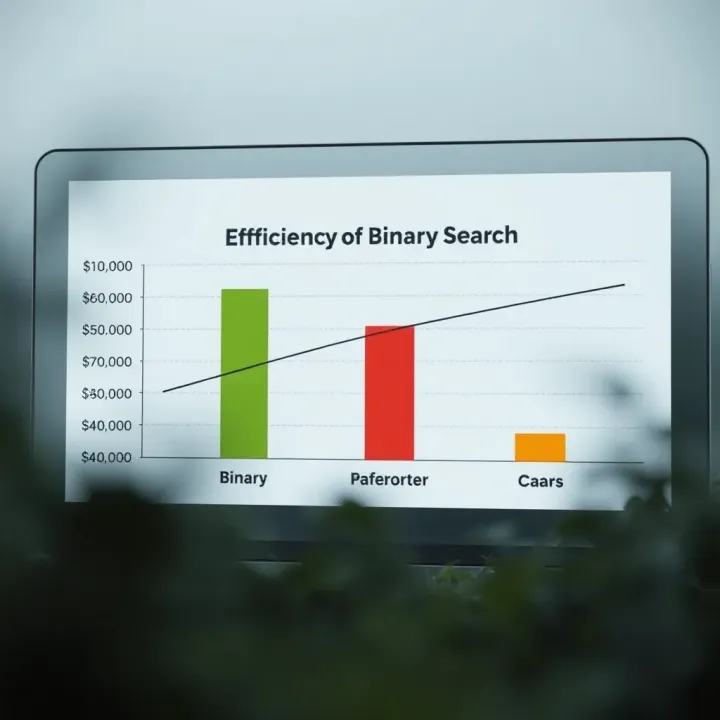
Binary search stands out as a powerful method for searching within large, sorted datasets. Its strength lies not just in speed but in its structured approach, which makes it a preferred choice over simpler methods like linear search for many applications, such as stock price lookups or searching records in sorted databases.
Binary search drastically reduces the time taken to locate an item compared to linear search, especially as dataset size grows. For instance, if you need to find a particular stock price from a list of 1 million entries, a linear search would check each entry one by one, potentially taking a long time. Binary search, however, splits the dataset repeatedly, slashing the number of comparisons needed to just around 20 (since log₂1,000,000 ≈ 20). This speed improves the responsiveness of financial apps or trading platforms where quick data access matters.
The concept of time complexity helps us understand how search time grows with data size. Linear search has O(n) complexity, meaning time grows directly with dataset size. Binary search operates at O(log n), where each step roughly halves the search space. This logarithmic growth means even if your data doubles from 1 lakh to 2 lakh entries, the search steps increase by only one. This makes binary search highly scalable and efficient for big data scenarios common in markets and analytics.
Binary search requires the list to be sorted to function correctly. This isn’t a major drawback because many real-world datasets—like ranked product prices, alphabetically sorted customer names, or sorted tax records—are already ordered or can be sorted once. Using binary search on these makes searching faster without needing to scan every item. For example, if a stock portfolio is sorted by ticker codes, locating any stock’s details becomes straightforward through binary search.
A key limitation is that binary search only works effectively on sorted lists. In cases where data is randomly ordered or frequently changing—for example, incoming real-time updates of trade orders—the method needs additional steps to maintain sorting, which might add overhead. For dynamic data streams, this makes binary search less suitable than quick unsorted searches like hash-based lookups.
Binary search is not the best fit when the dataset changes often through frequent insertions or deletions. Consider an evolving client list in a CRM system; constantly keeping it sorted for binary search can be resource-intensive. Data structures like balanced trees or hash tables might perform better here because they handle dynamic updates efficiently without full reordering.
When there are multiple identical entries, binary search can locate an occurrence but may not find all without extra work. For example, if a sorted list has many repeated stock prices, finding the first or last occurrence of a specific value requires modifications or additional logic like searching in sub-arrays after the initial match. This detail is crucial in financial analysis where duplicate records are common.
Binary search excels with large, ordered datasets but demands understanding of its limits, especially regarding data order and updates. Knowing when to use it can save time and improve search efficiency in trading, investing, and analytical tools.
In summary, binary search offers remarkable speed advantages over linear search, particularly in large-scale, stable datasets common in Indian financial and tech sectors. But you have to keep in mind its need for sorted data and challenges with dynamic or duplicate-heavy data before applying it in your projects.
Implementing binary search in programming is crucial for developers aiming to deal efficiently with large, sorted data collections. This method drastically cuts down search time compared to linear search, especially when handling datasets such as sorted arrays or lists commonly found in stock trading apps and financial analytics. Understanding how to code binary search also helps Indian beginners and students grasp the fundamentals of time complexity and algorithm optimisation.
Python's simplicity makes it ideal for demonstrating binary search. Using built-in functions and clear syntax, you can implement binary search in just a few lines. For instance, with a sorted list of stock prices, the function quickly narrows down the target price by repeatedly halving the search range. Python’s bisect module offers practical tools to handle insertion and searching, which adds to its popularity among developers.
C++ offers more control over memory and performance, useful for high-frequency trading systems or real-time analytics used on Indian exchanges like NSE or BSE. When implementing binary search in C++, using iterators instead of raw indices can make code safer and more flexible. Also, writing templates allows the same binary search code to work across various data types, which can be particularly helpful when working on diverse financial instruments.
Java’s utility classes like Arrays provide a binarySearch method out of the box, simplifying implementation for Indian software engineers. However, custom implementations allow tweaks like handling duplicate entries or searching within ranges, especially when developing apps dealing with fixed deposits or mutual fund NAV data. Java’s strong type system and portability make it a common choice in corporate banking software.
The iterative binary search uses loops to narrow down the search space, while the recursive version calls itself with adjusted pointers until the target is found or the range is empty. Iterative methods tend to be straight forward and avoid function call overhead, making them simpler to debug. Recursive implementations are elegant and map closely to the conceptual divide-and-conquer strategy, which can make the logic easier to follow for learners.
While both approaches share the same theoretical time complexity, O(log n), iterative binary search often runs slightly faster in practice because it avoids the overhead of repeated function calls, which is significant in resource-constrained environments like mobile apps. Recursion, however, can lead to stack overflow if not carefully managed, especially in languages without tail-call optimisation.
Choose iterative binary search for performance-critical applications where memory and speed matter, such as real-time financial analysis or embedded systems in Indian railway ticket booking. Recursion suits educational or prototyping cases where code clarity is important, or when the language environment optimises recursive calls efficiently. Understanding both techniques equips developers to pick the right approach based on project needs.
Implementing binary search properly across popular programming languages strengthens algorithmic thinking and equips developers to handle sorted datasets efficiently, a common requirement in Indian tech applications dealing with finance, e-commerce, and data analysis.
Python's clarity helps beginners learn quickly
C++ offers performance for demanding tasks
Java provides robustness and built-in utilities
Choosing between iterative and recursive implementations depends on the use case context and environment constraints, balancing clarity and optimisation effectively.
Binary search powers many practical tasks beyond theory, especially when working with large, sorted datasets. This method itself is quick and reliable, saving precious time in areas where search efficiency directly impacts performance and user experience. Indian developers and learners can appreciate how widely binary search is embedded in daily technology use, from shopping apps to backend systems.
Searching within sorted lists in e-commerce: Popular e-commerce platforms such as Flipkart and Amazon India depend heavily on binary search to sift through millions of product entries quickly. When users filter items by price or ratings, the backend uses binary search on sorted lists to instantly narrow down relevant products. This approach ensures customers get nearly instant results even during busy festive sale seasons, where heavy traffic demands rapid database queries.
Finding values in financial data: Investors and traders rely on real-time financial data analysis where thousands of stock prices and transaction records are sorted chronologically or by price. Binary search facilitates fast lookups for specific stock ticks or historical values in large datasets. This speed helps traders respond promptly to market changes, manage portfolios, or perform technical analysis using structured data stored in sorted order.
Indexing and retrieval in digital libraries: Academic portals and digital libraries like those provided by IITs or government repositories organise documents, research papers, and metadata in sorted indexes. Binary search helps users find exact documents or citations without scanning entire collections, which can be huge. Efficient retrieval becomes especially important when handling millions of records and catering to a large number of simultaneous users.
Debugging and optimisation techniques: Developers apply binary search-like methods while debugging to locate the source of errors quickly. For instance, when identifying which commit introduced a bug in a vast codebase, they can halve the search range repeatedly to pinpoint faulty code faster. Similarly, optimisation algorithms often incorporate binary search approaches to find minimal or maximal values over sorted sets, improving performance steadily.
Network packet searches: In networking, routers and security appliances often maintain sorted logs or packet sequences. Binary search allows efficient identification of specific packet IDs or timestamps, which is vital during traffic analysis or troubleshooting. Fast searching minimises latency and helps maintain network performance, especially in large-scale internet setups prevalent across India.
Decision-making algorithms: Binary search underpins various decision-making processes where choices depend on sorted lists of options or criteria. For example, in load balancing or resource allocation algorithms in data centres, binary search assists in swiftly narrowing down the best server or unit meeting certain thresholds. This efficiency reduces response times and boosts overall system reliability.
Binary search's widespread use across domains highlights its role as a backbone method—streamlining searches, enabling real-time processing, and enhancing user experiences in India's tech ecosystem.
Each example shows that binary search is not just an academic tool but a practical solution embedded deeply in the technology people use daily, especially within India’s growing digital infrastructure.
Comparing binary search with other search methods helps in choosing the right tool for the job, especially in trading, investing, or data analysis where speed and accuracy matter. Understanding differences in efficiency, data suitability, and resource use ensures better decision-making in practical scenarios.
Linear search checks each element sequentially until it finds the target or ends the list. This makes it slow for large datasets, taking on average O(n) time. For instance, searching a stock ticker in an unsorted database with 1,00,000 entries may be inefficient using linear search. Binary search, on the other hand, requires the list to be sorted but completes searches in O(log n) time by halving the search space every step. This means it can quickly locate a value, say, in a sorted list of historical prices, making it preferable for large, ordered datasets.
Linear search works on any dataset, sorted or not. This flexibility suits dynamic or smaller datasets, for example, searching through a list of unsorted daily transaction records in a small business. Binary search demands sorted data, so it fits situations where sorting is maintained, like arranged client portfolios or sorted commodity prices. Yet, sorting itself can be costly for frequently changing data, limiting binary search in such contexts.
Linear search requires minimal memory and is straightforward to implement, ideal for quick one-time checks or very small datasets. In contrast, binary search may need extra memory if it involves recursions or managing pointers but compensates with much faster search speeds. For applications like high-frequency trading platforms processing vast, sorted price feeds, speed gains from binary search outweigh minor memory overheads.
A binary search tree is a data structure where each node has up to two children, left and right, organised such that left children hold smaller values and right children hold larger ones. Unlike an array, BST dynamically adjusts as items are added or deleted without needing complete reordering. This dynamic nature allows efficient searches, insertions, and deletions, useful in portfolio management software that constantly updates asset listings.
While binary search in arrays requires data to be static and sorted, BSTs allow for faster dynamic updates without resorting to re-sorting entire datasets. For example, a real-time trading application adding new deals continuously benefits from BSTs, which maintain search speeds close to O(log n) while handling frequent changes effectively.
BSTs excel where data changes often, like order books in stock exchanges or live inventory systems in e-commerce. Their structure supports not only searching but also quick insertion or deletion of entries, maintaining overall performance. This makes them handy when datasets cannot remain static but still need fast lookup capabilities.
Choosing between search methods depends on data characteristics and application needs. For static, large sorted datasets, binary search on arrays works best. For dynamic datasets, BSTs offer a flexible and efficient alternative, while linear search remains useful in simple or unsorted cases.
Learn how binary search swiftly locates elements in sorted arrays by halving intervals each time. Master its logic, coding techniques, efficiency, and tips for smooth implementation 📊🔍

🔍 Understand binary search output thoroughly — learn how it works, interpret varied results in programming, and solve common challenges with real examples.

🔍 Understand binary search—an efficient way to find data in sorted arrays. Learn its workings, benefits, comparisons, common errors, and optimisation tips for developers.

🔍 Explore how binary search streamlines finding values in sorted lists. Learn its step-by-step logic, coding tips, common errors to avoid, and real-world uses.
Based on 6 reviews