

Optimal Binary Search Trees Explained
Explore how optimal binary search trees work ⚙️ in algorithms design, with examples, construction techniques, and key applications for computer science learners and pros 💻.
Edited By
Emily Bennett
Binary trees form the backbone of many computer science problems and solutions, especially in programming and algorithms. Simply put, a binary tree is a hierarchical data structure where each node has at most two child nodes — typically called the left and right child. This simple yet versatile structure helps organise data in an efficient way for search, insertion, and deletion.
You can think of a binary tree as a family tree, but limited to two children per node instead of many. For instance, in programming, binary trees are commonly used to implement binary search trees (BSTs) that speed up data retrieval, or heaps that support priority queue management.
Understanding the basic structure of binary trees is essential for tackling more complex data structures and designing efficient algorithms.
Node: The fundamental unit containing data, and links to left and right child nodes.
Root: The topmost node from which traversal begins.
Leaf: Nodes with no children.
Subtree: Any node along with its descendants forms a subtree.
Each node’s position and linkage determine its place in the structure and influence operations such as traversal or modification.
In practical terms, binary trees help reduce time complexity in search operations compared to linear structures. For example, a well-balanced binary search tree allows searching in O(log n) time rather than O(n) in arrays or lists. This proves especially useful in scenarios like managing databases or implementing symbolic expressions.
Indian learners often encounter binary trees during competitive exams like JEE, where questions test understanding of tree traversals or height computations. For software developers, mastering binary trees improves problem-solving skills related to data storage, sorting algorithms, and expression parsing.
To sum up, binary trees provide a clear, organised approach to handling hierarchical data efficiently. In the next sections, we will explore different types of binary trees, traversal techniques, and common applications relevant to programmers and analysts alike.
Understanding the basics of binary trees is vital for anyone keen on algorithms or data structures, especially for investors, traders, analysts, and students involved in computational problem solving. Binary trees form the backbone of many advanced structures, such as binary search trees and heaps, which power efficient searching, sorting, and decision-making in real-world applications.
A node in a binary tree holds data and links to its child nodes. This fundamental unit represents actual values or references in programming. For instance, in a binary search tree (BST) used for storing stock prices, each node may hold the price of a share alongside pointers to lesser and greater values. Understanding nodes helps you grasp how data is organised hierarchically, making searching quicker than simply scanning a list.
The root is the topmost node, the starting point of the tree. From here, all other nodes branch out. Internal nodes have at least one child; leaf nodes have none. Visualise an organisational chart where the CEO is the root, managers are internal nodes, and employees without subordinates are leaves. Recognising these roles clarifies navigation and update routines in trees.
Edges connect nodes—they’re the links showing parent-child relationships. Levels indicate the distance from the root, starting at zero. For example, a node at level two is two steps away from the root. These concepts are crucial when implementing traversals that process nodes level-wise, like breadth-first search (BFS), which is common in shortest path problems or network analysis.
The degree refers to the number of children a node has. In binary trees, this is at most two. This property limits the tree’s branching and affects complexity. For example, a node with degree two splits data into two categories, useful in decision-making algorithms, such as determining whether a customer qualifies for a loan based on yes/no criteria.
Height measures the longest path from a node down to its furthest leaf, while depth measures how far a node is from the root. These measures impact traversal efficiency: a tree with height five processes faster than one with a height of 20 for the same number of nodes. Traders analysing trends might prefer balanced trees with smaller heights for faster data retrieval.
A full binary tree has nodes with either zero or two children, while a complete tree is filled from left to right without gaps. Perfect trees are both full and complete, with all leaves at the same level. For example, heap implementations in priority queues are often complete binary trees because they support efficient insertions and deletions. Knowing these types helps optimise storage and algorithm performance.
A solid understanding of these basics lays the foundation for grasping complex operations and applications of binary trees in computing and finance.
Key points to remember:
Nodes form the building blocks and have distinct roles
Edges and levels determine tree structure and traversal strategies
Properties like height and completeness influence performance
This foundational knowledge will make it easier to explore variations like binary search trees and balanced trees next.
Binary trees come in different shapes and rules, each suited for particular tasks and optimisations. Understanding these variations helps you pick the right structure for your needs, be it fast searching, balanced data storage, or priority management. Let’s explore the most common types used in programming and data handling.
A Binary Search Tree (BST) maintains a simple but powerful rule: for every node, all values in its left subtree are smaller, and all values in its right subtree are larger. This property creates a natural order, which makes searching and sorting much more efficient than in a plain binary tree.
The BST’s ordering is like a phone directory arranged alphabetically. If you are looking for a name, you don’t have to check every entry; instead, you follow the order to quickly narrow down where the name might be. This method works well for datasets like student records or stock prices where fast lookup and insertion are needed.
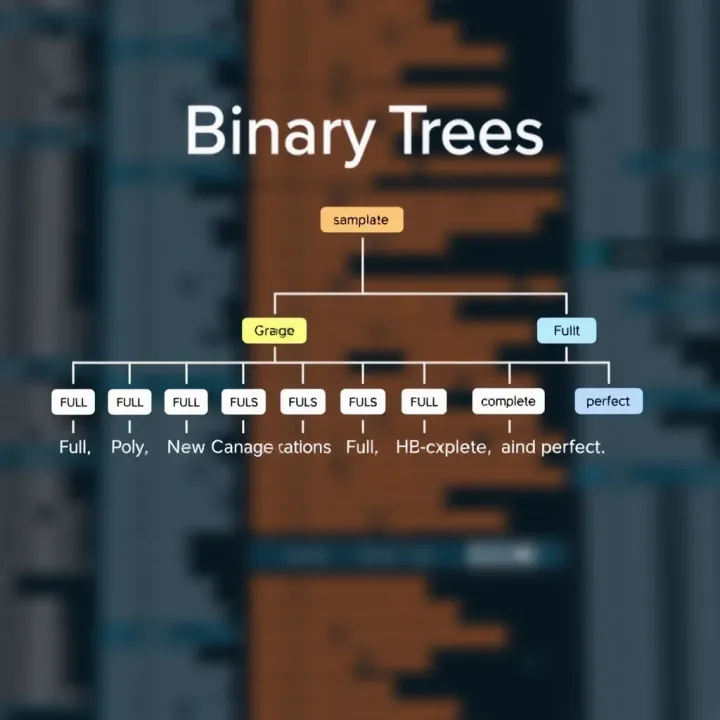
Searching in a BST involves comparing the target value with the current node’s key, then deciding whether to move left or right. This approach typically results in O(log n) time complexity if the tree is balanced. For example, if you want to find a specific company’s share price in a stock database sorted as a BST, you can quickly reach the record without scanning all entries.
Insertion follows the same path as searching. Once the correct spot is found where the new value fits the ordering rule, the node is added. This simplicity ensures updates happen efficiently, but if not managed, BSTs can become skewed — turning into linked lists and losing performance.
AVL trees are BSTs that keep themselves balanced to maintain quick search times. After every insertion or deletion, these trees check if balance is disturbed — specifically, if the height difference between left and right subtrees of any node is more than one.
To fix imbalance, AVL trees perform rotations: either a single rotation or double, depending on the case. Think of these rotations as rearranging files on a desk to keep everything neat and reachable. This balancing act greatly reduces the worst-case searching time, which matters when handling large datasets like transaction records or user profiles.
Red-Black trees are another balanced binary tree variant, but they use colour properties (red or black) to maintain balance during insertions and deletions. Unlike AVL trees, which enforce strict balance, Red-Black trees allow a bit more flexibility, which simplifies the balancing operations.
This gives Red-Black trees a performance advantage in systems where insertions and deletions happen frequently, such as operating system schedulers or database indexing. They guarantee that the path from root to the farthest leaf is no more than twice as long as the shortest path, ensuring predictable performance.
Heaps are binary trees structured to always have the largest (max-heap) or smallest (min-heap) value at the root. They aren’t ordered like BSTs but satisfy the heap property, where parent nodes dominate their children.
Heaps are widely used to implement priority queues, which manage tasks by priority. For instance, in a call centre software handling customer requests by urgency, heaps ensure the most critical issue gets addressed first. Insertions and deletions in heaps typically happen in O(log n) time, making them efficient for dynamic priority management.
While not strictly binary trees, tries (or prefix trees) are related structures that store strings in a tree-like form. Each node represents a character, and paths from root to leaves form words.
Tries shine in applications like autocomplete and spell checking. Imagine typing a search in an e-commerce app like Flipkart; a trie-based system quickly narrows down product names starting with typed letters. This avoids redundant comparisons, speeding up suggestions and improving user experience.
These variations of binary trees address specific performance needs — from search efficiency in BSTs and AVL trees, fair balancing in Red-Black trees, priority handling in heaps, to fast string lookups in tries. Choosing the right one depends on your application’s context and data characteristics.
Operations on binary trees form the backbone of how these data structures are used practically. These operations include insertion, deletion, searching, and traversal. Mastering them helps you manipulate trees efficiently, adapting them for applications such as database indexing, expression parsing, and even building search engines. Understanding these operations is especially relevant for beginners and analysts aiming to optimize performance and correctly maintain tree structure.
Simple Binary Trees involve straightforward insertion and deletion. When inserting a node, you usually add it as a child of an existing node without any ordering constraints. For example, in a family tree representation, a child node can be added under any parent. Deletion here is simpler too; you can remove a leaf node directly or restructure if it's an internal node. This approach works for small datasets or non-search-specific uses but doesn’t offer efficient lookup.
Binary Search Trees (BSTs) require insertion and deletion operations that keep the tree ordered based on node values. When inserting, you compare the value with the root and descend either left or right subtrees, maintaining the BST property where left child nodes contain smaller values and right child nodes contain larger ones. Deletion must consider three cases: deleting a leaf node, deleting a node with one child, and deleting a node with two children, often replacing the latter with its inorder successor. This organisation greatly improves searching speed, making BSTs favoured for databases and indexing.
Depth-First Search (DFS) explores as far down a branch as possible before backtracking. It has three main variants: inorder, preorder, and postorder traversal. DFS is useful when you want to explore entire subtrees or find paths between nodes. In programming challenges or applications like puzzle solving, DFS efficiently traverses complex tree or graph structures by diving down branches.
Breadth-First Search (BFS) explores nodes level by level, starting from the root and moving outwards. BFS is particularly effective for finding the shortest path in unweighted trees or graphs and is widely used in networking and social media algorithms. For instance, BFS helps determine the minimum number of connections between two users in a social graph.
Inorder Traversal processes the left subtree, then the node, and finally the right subtree. For BSTs, this traversal returns node values in sorted order. This property is handy for tasks like printing sorted data or verifying tree correctness. For example, extracting student records in ascending order based on their ID can use inorder traversal.
Preorder Traversal visits the current node before its child subtrees. Preorder traversal is useful for copying trees or expressing them in prefix notation, which compilers use to understand expressions before evaluation. It also helps in reconstructing a tree from its traversal output.
Postorder Traversal processes child nodes before the parent node. This approach is ideal for deleting nodes safely or evaluating postfix expressions in calculators. It also helps when releasing resources in a bottom-up manner, as in garbage collection.
Level Order Traversal is a BFS variant that visits nodes level by level, making it valuable for scenarios needing a top-down view. It finds use in printing tree structures in user-friendly formats or managing tasks like scheduling processes in operating systems.
Understanding and implementing these operations correctly allows you to harness the full potential of binary trees across numerous computing applications. Practical use cases in technology, from database indexing to compilers, demonstrate their ongoing relevance.
Binary trees aren't just abstract structures in textbooks; they power many practical systems and algorithms you use daily. Their efficiency in organising data helps speed up searching, sorting, and even parsing complex expressions. This makes them invaluable for students, analysts, and developers working on scalable, real-time applications.
Binary Search Trees (BST) allow rapid searches by organising data where every left child node contains smaller values and right child nodes contain larger ones. This structure trims down the search space sharply. For instance, if a trader wants to quickly find a particular stock's data among thousands, a BST can locate the entry in logarithmic time, saving valuable seconds.
In the Indian e-commerce sector, platforms like Flipkart manage massive product databases where quick searching is necessary. BSTs contribute to efficient retrieval of product details, enhancing user experience. The balance of a BST, however, is key; an unbalanced tree may slow down searches, so variants like AVL and Red-Black trees come into play to keep operations fast.
Trees can also help sort data efficiently. An inorder traversal of a BST yields elements in ascending order naturally. This property is leveraged in algorithms where sorting isn't just about numbers but more complex data, like sorting employee records by salary and joining date.
For example, a payroll system in an Indian corporate might use this to organise employee data quickly, ensuring timely salary processing. This sorting method is both intuitive and systematic, avoiding overheads common in traditional sorting techniques, especially for large datasets.
Expression trees represent mathematical expressions where leaves hold operands and internal nodes hold operators. This structure allows systematic evaluation and simplifies handling complex expressions.
Indian students preparing for competitive exams like JEE find expression trees useful to visualise and compute multi-part algebraic expressions step-by-step. Programmers use them to transform infix expressions (common in math) into postfix or prefix formats, facilitating easier computation.
Compilers employ binary trees to parse and generate code. Expression trees form part of syntax trees that compilers use to understand code structure, ensuring efficient translation to machine language.
In the Indian software industry, optimising compilers for languages like Java and Python relies heavily on these trees to improve performance and reduce runtime errors. Understanding this aids developers in grasping how their high-level code executes on hardware.
File systems use tree structures to organise folders and files hierarchically. Each folder can have subfolders or files, mirroring a binary or n-ary tree’s branching.
On Indian computers, the Windows or Linux file manager's folder structure is a practical example. This model allows users to navigate nested directories intuitively. The underlying tree facilitates fast locating, adding, or deleting files without searching an entire directory.
Binary trees form the backbone of indexing techniques that speed up data retrieval in databases. B-Trees and their variants, closely related to binary trees, manage huge amounts of records efficiently.
For example, banks in India use indexing to quickly access customer records or transaction histories from crores of entries. Well-designed indexes reduce query time drastically, which is vital for real-time banking and stock trading platforms. This highlights why understanding binary trees can lead to better design and optimisation of database systems.
Binary trees, beyond their academic roots, provide the framework for faster searches, organised data storage, and smarter computing, all of which are essential for today's technology-driven world.
Working efficiently with binary trees requires understanding not just their theory but also practical considerations that can impact performance and usability. This section offers tips that help you choose the right tree type, avoid common mistakes, and direct you towards valuable resources for further learning.
Balanced binary trees, like AVL or Red-Black trees, ensure that the tree's height remains logarithmic relative to the number of nodes. This balance is crucial when you expect frequent search, insertion, and deletion operations, such as in database indexing or real-time applications where speed matters. For example, if you're building a stock trading platform where quick retrieval of price data is vital, a balanced tree prevents the performance from degrading due to skewed structures.
In cases where the dataset is small or changes are minimal, simple binary trees suffice. These are easier to implement and require less overhead. For instance, if you’re just experimenting with tree traversal or working on a classroom project, a simple binary tree works well. Remember, overcomplicating with balanced trees when unnecessary can lead to wasted resources and increased code complexity.
Null pointers often cause runtime errors, especially during traversal or insertion. It's common to forget to check if a child node exists before accessing it, leading to crashes. Always include null checks to handle empty branches safely. For example, while implementing inorder traversal, confirm that a node’s left or right child isn't null before recursive calls. This practice safeguards your code and keeps operations smooth.
When using self-balancing trees, neglecting proper rotations after insertions or deletions can cause imbalance, negating the benefits of the structure. Keep track of balance factors or colour properties and apply necessary rotations immediately. In a trading app’s order book using Red-Black trees, ignoring this can slow down lookups drastically. Automated tests to verify tree balance are also helpful in preventing such pitfalls.
Classic books like "Data Structures and Algorithms in C++" by Goodrich or online courses on platforms like NPTEL provide solid foundations. They explain concepts step by step with Indian examples, which makes them more relatable. Supplementing reading with video tutorials on YouTube channels focused on Indian tech education can clarify tricky topics faster.
Platforms such as CodeChef, HackerRank, and GeeksforGeeks offer tailored challenges on tree data structures. These help in applying theoretical knowledge practically, improving problem-solving speed — especially handy for competitive exams like GATE or campus placements. Practising on these platforms also exposes you to Indian programming standards and test patterns, making preparation more relevant.
Remember, understanding the type of binary tree to use and common coding pitfalls can drastically improve your application’s efficiency and reliability. Pairing this with consistent practice solidifies your skills effectively.
Explore how optimal binary search trees work ⚙️ in algorithms design, with examples, construction techniques, and key applications for computer science learners and pros 💻.

Explore how optimal binary search trees improve search efficiency 📚. Learn dynamic programming methods, implementation tips, and real-world applications 🌐.

Explore how optimal binary search trees 📚 boost search speed by smart node arrangement. Learn dynamic programming, real-world uses, and performance tips.

🌳 Learn how to find the maximum depth of a binary tree with clear examples and code. Understand why depth matters for balanced trees and performance.
Based on 14 reviews