

Best Case Time Complexity of Binary Search Explained
🔍 Understand binary search's best case time complexity – how it swiftly finds elements in sorted arrays, why it matters for performance, and its comparison with average and worst cases.
Edited By
Emily Harding
Binary search is a widely used algorithm in computing for quickly finding an element in a sorted list. Understanding its best-case time complexity offers valuable insights into how and when it performs most efficiently. The best-case scenario occurs when the target element is immediately found at the middle index on the very first comparison, resulting in a time complexity of O(1).
This means the search ends in constant time, irrespective of the list's size, which contrasts with average and worst cases, where the algorithm divides the search space repeatedly. For example, consider a sorted array of stock prices for the past 1,00,000 days. If you are looking for the price on the 50,000th day and the middle element happens to be the same, binary search stops straight away—this is the best case.
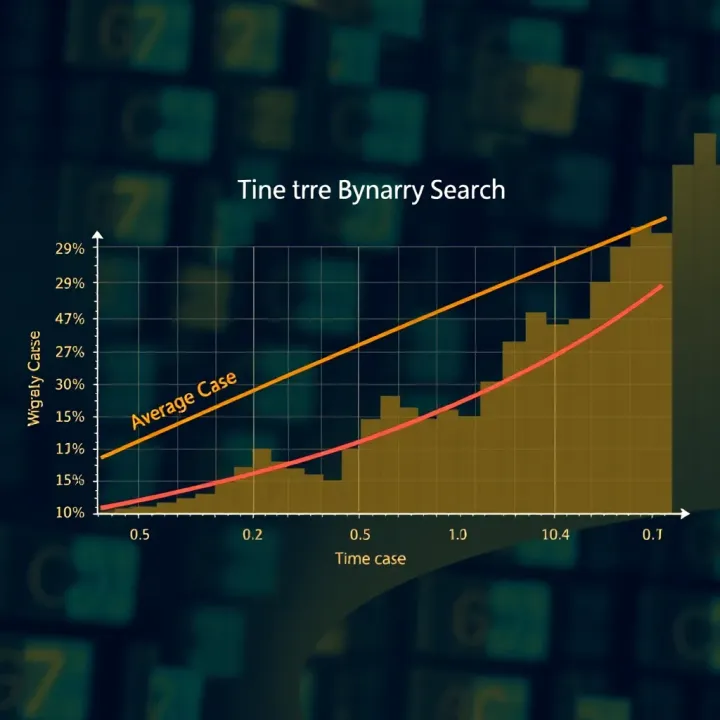
Knowing the best-case performance helps investors, traders, or students understand the algorithm's potential efficiency ceiling. However, it's equally important to consider average and worst-case complexities for realistic expectations. The best case shows how binary search can quickly save time in ideal conditions but should not be the sole basis for assessing overall efficiency.
Searching for a particular transaction ID in a sorted ledger.
Looking up stock prices by date in historical data.
Finding specific records during large-scale database queries.
In all these cases, if the target element aligns with the middle position early on, the search completes instantly, offering substantial time savings.
To sum up, binary search's best-case time complexity of O(1) reflects its ability to find an element in one step if conditions are perfect. Recognising this helps you appreciate why binary search is preferred over linear search for sorted data and when it truly shines in day-to-day computing tasks.
Binary search is a widely used algorithm that efficiently finds an element within a sorted list. Understanding its basics is essential because it forms the foundation for exploring its time complexities, particularly the best-case scenario. For example, in stock market data analysis, where prices are sorted by date, binary search helps quickly locate a specific day's price without scanning the entire dataset.
Binary search repeatedly halves the search space to zero in on the target element. Imagine searching for a name in a phone directory: instead of starting from the first page, you open the book roughly in the middle to check if the name is before or after that point. By splitting the data this way, it significantly cuts down the number of comparisons required.
This division continues until the element is found or the search space becomes empty. This progressive elimination is what leads to the algorithm's logarithmic time complexity in most cases.
Sorted data is the backbone of binary search. If the data isn't sorted, dividing the search space won't guarantee that half can be safely ignored. For instance, searching for a mobile number in an unsorted contact list using binary search would be pointless.
In practical terms, sorting a dataset before applying binary search is valuable when multiple searches are expected — like querying prices of various commodities over time. This upfront sorting investment pays off by speeding up subsequent searches.
Binary search follows clear steps:
Identify the middle element of the sorted array.
Compare it with the target element.
If they match, the search ends successfully.
If the target is smaller, repeat the search in the left half.
If the target is larger, focus on the right half.
This process repeats, reducing the search space each time. Its clarity and predictability make it a prime tool for fast data retrieval.
Without a sorted array, the binary search method breaks down. If data is unordered, the algorithm cannot confidently exclude any section from search, making a linear scan necessary instead. For example, in a stock portfolio where asset values fluctuate unpredictably, binary search is useless unless the data is first sorted.
Sorting takes time and resources; therefore, it's worthwhile mainly when searches happen repeatedly on the same dataset.

Binary search works best with indexed data structures like arrays or lists, where accessing the middle element is straightforward and quick. Using binary search on linked lists, which do not provide constant-time access to middle elements, is inefficient.
Therefore, choosing the right data structure influences binary search's real-world performance. For instance, in coding exams or competitive programming, arrays are preferred over linked lists when implementing binary search for speed.
Binary search's power lies in its straightforward method of halving the search space and relying on sorted data, but these conditions must be met to fully benefit from its efficiency.
Understanding the best-case time complexity of binary search is essential to grasp how efficient the algorithm can be under ideal conditions. This scenario highlights the minimum time required to locate an element when the search hits the target immediately, which contrasts markedly with average or worst-case times. Knowing this helps developers and analysts appreciate the potential speed of the algorithm and make informed choices in performance-critical applications.
Immediate element match happens when the binary search finds the target element at the very first divide. In a sorted array, the search begins by checking the middle element. If, by chance, this middle element is exactly what you're looking for, the search concludes instantly. For example, searching for 50 in an array of integers from 1 to 100, if 50 is at the middle position, the algorithm finishes after one comparison. This is a neat practical case but quite rare in random or unsorted scenarios.
When discussing comparison count in best case, it means only one comparison is needed. The first check confirms the element’s presence, so no further division or steps are necessary. In contrast, average or worst cases require multiple comparisons as the search space halves repeatedly. This single comparison dramatically lowers execution time, especially in large datasets, although such an occurrence depends wholly on the target’s position relative to the middle.
The best-case time complexity is denoted as O(1), which means constant time. No matter how large the dataset is, the operation takes a fixed number of steps—just one comparison in this case. This notation communicates that the time required does not grow with the input size when the best case occurs. It’s like having a shortcut directly to the answer, bypassing the usual divide-and-conquer process.
The practical meaning for algorithm efficiency is that O(1) best-case performance represents a theoretical limit rather than a guaranteed outcome. While it can happen, it's not typical for every search due to the random distribution of data or search targets. Recognising this helps set realistic expectations, especially in performance-critical environments like stock analysis or election result processing, where rapid lookups in sorted data can sometimes yield immediate results.
In short, best-case time complexity gives us the fastest possible search scenario for binary search. It reminds us how quickly the algorithm can perform, even while average and worst cases may take longer.
Understanding the differences between best, average, and worst-case time complexities in binary search helps clarify how the algorithm performs in various situations. While the best case shows the fastest possible execution, the average and worst cases offer more realistic expectations. For anyone relying on binary search—whether you're a student, analyst, or trader—knowing these distinctions aids in estimating efficiency and making informed decisions about algorithm use.
In average cases, the element you seek is not located immediately but somewhere in the array. Typically, binary search divides the search space by half at each step, leading to around log₂n comparisons where n is the number of elements. For example, if you search an array of 1,024 elements, you might expect about 10 comparisons (since log₂1,024 = 10). This is quite efficient compared to a linear search, which could take up to 1,024 comparisons in the worst case.
In real-world scenarios, the average-case performance tends to be close to the worst case since data is rarely arranged such that the target is always found immediately. For instance, in stock price databases or large customer records, elements will mostly be distributed throughout the sorted list. Using binary search here ensures consistent, logarithmic time to locate data, making it reliable for time-sensitive tasks like automated trading or real-time analytics.
The worst-case arises when the element is either absent or located at the extremities of the sorted array. Here, binary search must repeatedly halve the search space until only one element remains. The maximum steps required match the base-2 logarithm of the array size, i.e., log₂n. For example, searching one million entries means at most around 20 comparisons, which remains very manageable.
This logarithmic complexity, expressed as O(log n), implies the search time grows slowly even as the dataset becomes huge. This feature makes binary search particularly suited for large Indian databases—like Aadhaar records or stock market data—where quick retrieval is essential. The O(log n) complexity ensures that doubling the dataset size increases the steps by just one, keeping performance scalable and predictable.
Knowing the contrast between best, average, and worst cases helps set realistic expectations and guides choosing the right algorithm for your data size and structure.
By grasping these time complexity distinctions, you can optimise data searches effectively, especially in challenging environments like competitive programming or real-time financial analysis.
Practical examples help ground the abstract concept of time complexity in real-world scenarios. They show when the best-case scenario for binary search occurs and why it matters. Understanding these cases can guide you on when to rely on binary search for faster search operations, especially in large datasets common in Indian IT firms and academia. Use cases also demonstrate how the algorithm's efficiency translates into time saved during searches, making it more than just theory.
Searching for the middle element: The best-case arises when the target element is at the middle of the sorted array during the very first comparison. This means the algorithm immediately finds the element without needing further splits. For example, if you're looking for 50 in a sorted list of 1 to 100, and 50 is exactly in the middle, binary search finishes in just one step. This situation, though rare, is important because it shows the absolute fastest possible search time.
Impact on execution time: Finding the middle element first considerably reduces the number of comparisons, slashing the time a search takes. This saves both processing time and power, which is crucial when dealing with high-volume queries, such as database lookups or web searches. In Indian tech environments, where large datasets from sectors like e-commerce or finance are common, even minor improvements in search time can have significant effects on overall system performance.
Search operations in large datasets: Many Indian IT companies handle massive datasets from sectors like banking, telecom, and retail. Binary search, particularly at its best case, provides a reliable method to quickly find specific records out of millions. This helps in customer service systems or fraud detection, where quick retrieval is necessary. The efficiency also plays a part in improving user experience on platforms like Flipkart or Amazon India by speeding up inventory checks.
Role in competitive programming and exams: Binary search is a staple in Indian competitive programming contests such as CodeChef, HackerRank, and the International Olympiad in Informatics (IOI). Many problem statements rely on binary search concepts for efficient solutions. For students preparing for exams like JEE or UPSC that require logical problem-solving skills, mastering the best-case efficiency of this algorithm can help them write optimised code quickly, saving valuable exam time.
Binary search’s best-case speed isn’t just theoretical—it directly benefits practical computing tasks across Indian industries and competition platforms.
Binary search is famously efficient when applied correctly, but several factors can influence how well it performs in practice. Understanding these helps in optimising search operations, whether you're analysing stock trends or solving programming challenges.
Binary search works only on sorted datasets. If the data isn't sorted, binary search will likely return incorrect results or take longer, defeating its purpose. For example, if a list of customer IDs is in random order, running a binary search will not locate an ID reliably unless the list is sorted first. In India, many databases in banking and finance rely on sorted data for quick queries, underlining the value of maintaining order.
Sorting can be time-consuming for very large datasets, but it drastically reduces search time afterward. For instance, if traders want to find the latest stock price quickly in a sorted list, binary search offers huge time savings compared to a linear search through thousands of entries.
Choosing the right data structure affects binary search performance. Arrays or lists provide direct index access, which binary search requires. However, using linked lists makes it inefficient since moving to the middle element takes linear time, nullifying binary search's advantages.
For example, implementing binary search on a balanced Binary Search Tree (BST) can offer logarithmic search times similar to sorted arrays but with more flexible insertion and deletion. Indians involved in competitive programming often choose data structures carefully for optimal binary search performance.
Processor speed influences how quickly individual operations within binary search execute. A faster CPU reduces overall search time, making the inherent logarithmic efficiency of binary search even more pronounced.
However, the gain from high-speed processors may be less noticeable on small datasets. In bulk data processing situations like analysing millions of transaction logs, processor speed paired with efficient algorithms can reduce search times from minutes to seconds.
The choice of programming language affects binary search performance too. Languages like C++ provide low-level control and faster execution, ideal for systems where speed is critical, like real-time trading algorithms.
In contrast, languages like Python offer ease of coding but might be slower due to interpreter overhead. Indian software developers often weigh these trade-offs, choosing faster compiled languages for performance-critical applications and scripting languages for rapid development.
Efficient binary search depends not just on the algorithm but also on how data is organised and the computing environment. Optimising these factors helps you get the most out of your search operations.
🔍 Understand binary search's best case time complexity – how it swiftly finds elements in sorted arrays, why it matters for performance, and its comparison with average and worst cases.

🔍 Compare time complexity of linear vs binary search algorithms. Understand how data size impacts efficiency and choose the best method wisely.

Explore the space complexity of binary search 🔍, comparing iterative vs recursive methods and learn tips to efficiently manage memory in Indian computing contexts 💻.

📚 Explore the time complexity and dynamic programming behind optimal binary search trees. Learn how to minimize search time effectively in practical scenarios.
Based on 12 reviews