

Types of Binary Search Trees Explained
Explore various types of binary search trees (BSTs) 🌳, including balanced and self-balancing forms, their structures, uses, and advantages in programming and data management.
Edited By
James Bennett
Breadth First Search (BFS) is a fundamental algorithm used in traversing or searching tree and graph data structures. When it comes to binary trees, BFS explores nodes level by level, starting from the root and moving outward. This approach contrasts with Depth First Search (DFS), which dives deep into one branch before backtracking.
In practical terms, imagine you are navigating a family tree generation-wise rather than lineage-wise—that's BFS in action. It systematically visits all nodes at a certain depth before moving down to the next level.
BFS implementation typically relies on a queue data structure to keep track of nodes yet to be visited. Here’s what happens step-by-step:
Begin with the root node, enqueue it.
Remove the front node from the queue and process it (for example, print or check its value).
Enqueue its left child, then its right child, if they exist.
Repeat this cycle until the queue is empty.
This method ensures that nodes closer to the root are processed first, which is useful in scenarios like searching for the shortest path in unweighted trees or networks.
Unlike DFS, BFS guarantees discovering the shortest path to a node in terms of the number of edges traversed, making it especially valuable in routing and balanced tree assessments.
In Indian coding interviews and competitive programming, BFS in binary trees often comes up to test understanding of traversal logic and queue usage. Developers working with tree-like data on platforms such as Flipkart’s recommendation engine or the IRCTC seat allocation can also find BFS practical.
To sum up, BFS offers a clear strategy for scanning binary trees level-wise. It fits well where processing nodes in layers makes the problem simpler or more efficient. Next, we'll go into the exact code and some optimisations for BFS in binary trees.
Understanding how breadth first search (BFS) works on binary trees unlocks many practical applications in computing and data management. Binary trees provide a simple yet powerful way to organise hierarchical data, and BFS helps you explore such structures level by level, which often suits real-world problem-solving better than other methods.
A binary tree is a type of data structure where each node has at most two children, commonly referred to as the left and right child. This limitation shapes the tree’s structure, making operations like searching, inserting, or deleting nodes straightforward to implement. For instance, in decision-making systems or file directory layouts, binary trees efficiently represent choices or folder hierarchies.
Binary trees have specific properties such as depth (or height), where each level represents nodes equidistant from the root. This characteristic enables algorithms to process data in meaningful sequences. Practically, binary trees balance speed and memory use, making them popular for databases, indexing, and expression parsing.
Common types of binary trees include:
Full Binary Trees: Every node has either zero or two children. This structure is easy to manage but less flexible.
Complete Binary Trees: All levels are fully filled except possibly the last, which fills nodes from left to right. This type is often used in heap implementations.
Perfect Binary Trees: A stricter form where all internal nodes have two children and all leaves are at the same level. Ideal for balanced partitions in search problems.
Binary Search Trees (BST): Each node’s left child holds a smaller value, and the right child a larger value. BSTs enable fast search, insert, and delete operations.
Each type suits different scenarios. For example, BSTs are common in coding interviews and databases for efficient lookup, while heaps (complete binary trees) are key for priority queues.
The core idea behind BFS is to explore the nodes of a tree or graph level by level. Starting from the root, BFS visits all nodes at the current depth before moving one level deeper. This approach ensures the shortest path from the root to any node is found first, which proves useful in many algorithms.
An everyday example could be searching for a specific contact in a phonebook app structured as a binary tree. BFS quickly narrows down the search by scanning first across the top level entries before moving down, limiting unnecessary checks.
Compared to depth first search (DFS), which dives deep into one branch before backtracking, BFS provides a more balanced exploration. DFS might get stuck exploring an entire subtree before considering other branches, whereas BFS distributes attention evenly across levels. This distinction can affect efficiency and memory use depending on the tree's shape and the problem you want to solve.
BFS is especially useful where the closest solution or shortest path is preferred, like routing algorithms or level order traversal in user interface elements. DFS, while memory-friendly, suits scenarios needing exhaustive deep search, such as puzzle solving or backtracking techniques.
Remember: Choosing BFS or DFS depends on the problem's requirements — level-wise data processing calls for BFS, while depth exploration might lean towards DFS.
Understanding these basics offers a solid starting point to appreciate the practical power of BFS in binary trees and sets the stage for detailed algorithmic steps and implementations discussed later in the article.
Understanding how breadth first search (BFS) traverses a binary tree is key to grasping its practical applications. BFS explores the tree level by level, which helps in scenarios where knowing the depth or hierarchical structure matters. This approach contrasts with depth-first strategies that follow one branch down before moving on.
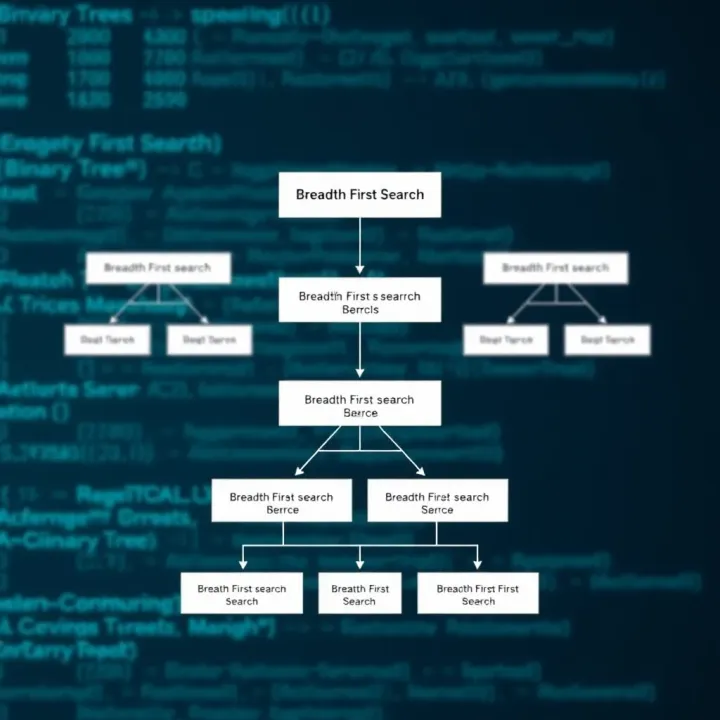
A queue is essential for implementing BFS efficiently. It acts like a line where nodes wait their turn to be processed. Starting with the root, nodes are removed from the front of the queue and their children are added to the back. This ensures nodes are visited in the correct order, level by level.
Queues help manage the order in which nodes are processed without getting lost in the tree. For example, in a tree representing family generations, BFS visits parents before children, making it easier to track relationships.
Processing nodes level by level means BFS completes one level entirely before moving to the next. This behaviour is particularly useful when you need to perform actions based on depth — such as finding all nodes at a certain level or shortest path calculations.
When used in decision trees or network routing, examining levels systematically can reveal layers of possible choices or hops, respectively. This clarity would be harder to get with depth-first methods.
Consider a simple binary tree with a root node 1, with two children 2 and 3. Node 2 has children 4 and 5, while node 3 has child 6. BFS would visit nodes in this order: 1 → 2 → 3 → 4 → 5 → 6. This sequence mirrors nodes being explored level by level from the root down.
This walk-through helps internalise BFS logic beyond theory. Visualising node visits by level shows why BFS can better suit problems that require an understanding of a tree’s breadth.
Throughout BFS, the queue updates dynamically. Starting with 1 in the queue, we remove it and add its children 2 and 3. Next, remove 2 and enqueue 4, 5. Then remove 3 and enqueue 6. The queue contents change as [1] → [2,3] → [3,4,5] → [4,5,6], and so on till all nodes are processed.
This illustrates the organised way BFS handles nodes and prevents skipping any node. Tracking the queue gives visibility on the traversal order and memory involved in the process.
A clear grasp of BFS traversal helps in understanding its strengths, especially when applied to tasks like level-order traversal and shortest path problems in binary trees.
Implementing Breadth First Search (BFS) in code bridges the gap between theoretical understanding and practical application. This section is crucial for learners and professionals alike because it shows how BFS can be translated into effective, usable programs to traverse binary trees. Clear and efficient implementation helps in tasks such as searching for nodes, processing hierarchical data, and optimising algorithms for performance.
Pseudocode provides a language-agnostic way to outline BFS logic before diving into actual programming. It simplifies the algorithm into clear steps, making it easier to visualise the process without the distraction of language syntax. For example, the pseudocode might start with creating an empty queue, enqueuing the root node, and then visiting nodes level by level. This approach benefits beginners as it builds a strong foundation and allows easy translation to any programming language later.
Java and Python are popular choices for demonstrating BFS due to their readability and widespread use. In Java, BFS typically involves using a Queue interface, such as LinkedList, to keep track of nodes during traversal. Python’s collections.deque works well as a queue due to its efficient append and pop operations. Implementing BFS in these languages helps illustrate memory management and iteration clearly. For instance, Python code for BFS on a binary tree focuses on simplicity and clarity, which is ideal for beginners and students working on algorithm problems.
Considering edge cases like empty or single-node trees is essential for a robust BFS implementation. An empty tree means there is no root node, so the algorithm must handle this by returning immediately or signalling that traversal isn’t possible. For a single-node tree, BFS should simply visit that node and stop without errors. Handling these scenarios ensures that the code can manage all possible inputs reliably without crashing or producing incorrect results.
Optimising BFS largely depends on efficient use of data structures and early termination when possible. Using queues that support O(1) insertion and deletion, like deque in Python or LinkedList in Java, helps keep operations fast and memory usage reasonable. Further, pruning branches that aren’t necessary for a particular search or stopping once the target node is found can save time. In large binary trees, these optimisations make a real difference, preventing unnecessary processing and keeping resource usage manageable.
Efficient BFS implementation not only aids understanding but also supports real-world applications where performance can impact user experience or resource costs.
By focusing on clear pseudocode, practical coding examples in Java and Python, and addressing edge cases along with optimisation, this section equips readers with the tools needed to confidently apply BFS on binary trees in various programming contexts.
Breadth First Search (BFS) finds practical use across various areas where binary trees are involved. Understanding its applications helps clarify why BFS is a preferred traversal method in certain scenarios. This section will look at key uses such as finding shortest paths, level order traversal, and real-world problems including tree-based data handling and network routing.
Level order traversal processes nodes layer by layer, which naturally corresponds with BFS’s approach. This allows you to visit all nodes at a given depth before moving deeper. For example, when representing organisational hierarchies or family trees, BFS helps retrieve data in levels, making it easier to present or analyse.
One practical application is in printing nodes level-wise, useful in visually structuring tree data. Unlike depth-first methods, BFS quickly reveals the shallowest nodes first, which often corresponds to a broader overview before details.
Distance calculations rely on BFS to determine the shortest path or minimal steps from the root node to any other node. This is particularly helpful in scenarios such as game development, where calculating moves on a decision tree or finding the nearest accessible point matters.
The traversal ensures that as soon as a node is reached, the path taken is the shortest. For example, BFS can be used to calculate minimum connections in a social network or packet hops in a network modelled as a binary tree.
Tree-based data processing often depends on BFS when batch processing nodes by their level or distance from a source. Consider an inventory system organised as a binary tree where BFS helps update or retrieve items layer-wise, leading to efficient database operations or bulk updates.
In Indian e-commerce platforms, representing categories as trees and scanning them using BFS can help in dynamic filtering or rendering of product lists grouped by hierarchy.
Network routing and decision trees benefit greatly from BFS due to its level-wise exploration. In routing, BFS can help identify shortest paths between nodes, crucial in optimising data packet travel.
Decision trees used in machine learning or business forecasting also use BFS to evaluate outcomes level by level, speeding up the decision process and helping explain model choices transparently.
BFS's ability to handle level-wise processing and shortest path discovery makes it invaluable for practical applications across computing, networking, and data analysis where binary trees are utilised.
Analyzing the performance and complexity of Breadth First Search (BFS) on binary trees helps you understand how efficiently this traversal method works in different scenarios. This knowledge is especially relevant when working with large datasets or real-time applications where speed and memory usage matter.
The time taken by BFS largely depends on the size of the binary tree, specifically the number of nodes it contains. BFS visits every node exactly once, so its time complexity is O(n), where n represents the total number of nodes. This linear relationship means that traversal time grows directly with the tree's size, making BFS predictable and manageable even for larger trees like those with 1,00,000 nodes.
Practically, this implies that whether you have a small search tree for organising a database index or a larger decision tree in artificial intelligence, BFS performance scales consistently. It systematically processes nodes level by level, ensuring that each node gets visited once without redundancy.
Comparing BFS with Depth First Search (DFS) also highlights some contrasts in time complexity. Both BFS and DFS have the same theoretical time complexity, O(n), as they both explore all nodes. However, their operational behaviour differs. DFS goes deep into one branch before backtracking, while BFS explores neighbours first. This difference can affect runtime depending on the tree's structure and the problem at hand.
For instance, if you're searching for a node near the root, BFS might find it faster because it checks nodes level-wise. On the other hand, DFS might be preferable when memory is limited, or you're dealing with very deep but narrow trees, since it requires less overhead compared to the queue used in BFS.
BFS requires additional memory for its queue, where nodes awaiting processing are stored. The key point here is the queue size in worst-case scenarios. The largest number of nodes held in the queue corresponds to the maximum width of the tree—that is, the largest number of nodes at any single level.
For a balanced binary tree, the last level has the most nodes, roughly half of all nodes, so the queue could hold up to about n/2 nodes. This means space complexity can reach O(n) in the worst case. If you're handling trees with millions of nodes, this queue size could impact memory substantially.
Considering memory usage, BFS can consume more memory than DFS, which uses a stack that grows with tree depth rather than width. For wide trees, the extensive queue size means BFS demands more RAM. This might limit BFS applicability on devices with restricted memory, like embedded systems.
Knowing when to pick BFS over other traversal methods depends not just on the speed but also on the memory footprint. It’s wise to assess tree shape and size before choosing the appropriate algorithm.
In summary, BFS offers predictable linear time traversal, but its memory consumption is sensitive to the tree’s breadth. Understanding these aspects prepares you for optimising BFS in real-world applications, whether processing data, finding shortest paths, or solving tree-based problems efficiently.
Explore various types of binary search trees (BSTs) 🌳, including balanced and self-balancing forms, their structures, uses, and advantages in programming and data management.

Explore how optimal binary search trees work ⚙️ in algorithms design, with examples, construction techniques, and key applications for computer science learners and pros 💻.

Explore binary search trees (BST) 📚 in data structures, their efficient data organisation, key operations, traversal methods, and real-world computing uses with clear examples.

Explore how dynamic programming builds optimal binary search trees to cut search costs in computing. Learn algorithms, examples, and real-world uses 🖥️🔍
Based on 7 reviews