
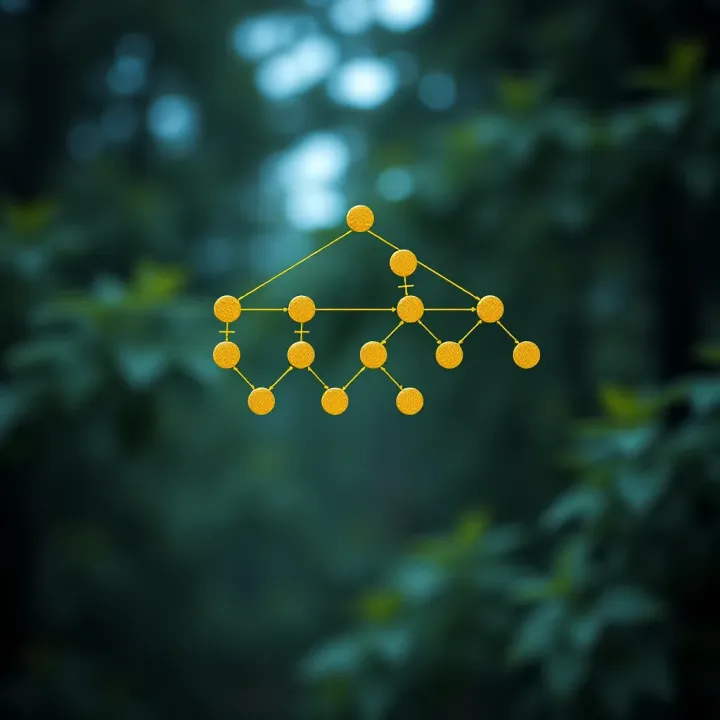
Understanding Binary Tree Maximum Height
Learn how to find the maximum height of a binary tree 🌳, why it matters in programming, and the best methods to calculate it effectively 🧮.
Edited By
Amelia Scott
The height of a binary tree is one of the most fundamental concepts in computer science and programming. It measures the longest path from the tree's root node down to any of its leaf nodes. In simpler terms, imagine starting at the top of a family tree and counting the largest number of generations down to the furthest descendant—that count represents the height.
Understanding the height is essential because it directly impacts the efficiency of operations like searching, insertion, and deletion in tree-based data structures. For instance, a taller binary tree can mean more steps to find a value, slowing down performance. On the other hand, a balanced tree, where the height is kept minimum, allows faster access and manipulation.

This concept is especially important for beginners learning data structures and for analysts working with algorithms. It provides insight into how well a binary tree performs in applications such as database indexing, file system organisation, and real-time computing.
The height determines the worst-case time complexity for many operations in a binary tree, so mastering how to calculate it is vital.
Definition: Height is the number of edges on the longest path from root to leaf.
Leaf Node: A node without children, marking the end of a path.
Empty Tree: Considered to have height -1, since there are no nodes.
Single Node Tree: Height is 0, as the root is also a leaf.
Suppose you have a binary tree representing a company's hierarchy, with a CEO at the root. The height tells you the maximum levels of management from the CEO down to the lowest-ranking employee. If the tree's height is 4, it means there are five management levels including the CEO.
Knowing this helps in planning communication flow or detecting bottlenecks.
In the following sections, we will explore algorithms to calculate this height efficiently and understand how different tree shapes affect overall performance.
A binary tree is a data structure where each node has at most two children, traditionally called left and right. This simple structure underpins many applications, such as expression parsing, decision making in games, and organising hierarchical data.
Each node in a binary tree has a level and a depth. The level indicates the node’s distance from the root node, which is at level one. The root’s immediate children are at level two, and so on. Depth usually means the number of edges on the path from the root to the node. These measures help us locate nodes and understand the tree’s shape, especially when balancing it.
Height and depth are closely related but look at the tree from opposite directions. While depth measures how far a node is from the root, height measures how far the longest path is from a node down to the farthest leaf. The height of the entire tree equals the depth of the deepest leaf. This connection helps in algorithms where you need to compare paths going down from the root or climbing up from leaves.
Height plays a key role in determining the performance of tree operations. Taller trees may cause slower search times since you might need to traverse more levels. Hence, balanced trees with smaller heights are preferred in databases or file systems to keep retrieval fast. For traders and investors, efficient data retrieval can mean quicker decisions.
Many confuse height with depth, sometimes assuming they are interchangeable. Another common mistake is expecting height to count the number of nodes, but it actually counts edges along the longest path from root to leaf. Also, beginners might think all trees have the same height for a given number of nodes, yet skewed trees can have significantly larger height than balanced ones.
Remember, understanding these distinctions is not just academic—it impacts how you design algorithms and manage data structures effectively.
This clarity about height versus depth forms the backbone for deeper studies on binary trees, including how to calculate height and why optimising it matters for system performance.

Calculating the height of a binary tree helps us understand the tree's structure and efficiency. The height defines how deep or tall the tree is, which ties directly into how quickly operations like search, insertion, and deletion can happen. A greater height often means slower operations, as more nodes must be checked sequentially. This makes learning how to calculate height essential for anyone working with data structures, algorithms, or system design.
Recursion suits trees because they naturally break down into smaller subtrees. Each node in a binary tree can be seen as the root of its own subtree. When we calculate height recursively, the function calls itself on each child node, simplifying the problem step by step.
The basic idea is simple: if a node is null (no child), we've reached beyond leaf level, so height is zero. Otherwise, we find the height of both left and right subtrees, then add one for the current node's level. For example, if the left subtree is 3 levels deep and the right is 5, the node's height is 1 plus the greater of the two, here 6. This approach naturally covers all parts of the tree.
While recursion feels intuitive, iterative methods show their strength when stack overflows are a risk, especially in very tall trees. One common way is level order traversal, which looks at nodes level by level rather than deeper down a single branch.
Level order traversal uses a queue to keep track of nodes at each depth. Start by adding the root to the queue. Then process nodes in batches: all nodes at the current level are removed from the queue one by one, and their children are added for the next level. Counting how many levels we traverse gives the tree's height. For instance, if there are four rounds of processing, height is four.
This queue-based method is practical in real-world scenarios like network routing or file system indexing, where iterative control helps manage resources better than deep recursive calls.
Calculating tree height using these methods helps optimise many algorithms, ensuring faster data retrieval and storage in diverse applications.
The height of a binary tree directly influences how efficiently algorithms perform, especially for search and insertion operations. In simple terms, the height determines the number of steps needed to locate or add an element, impacting time complexity. For example, in a binary search tree (BST), if the height is minimal (logarithmic in terms of number of nodes), search and insert can happen quickly, often in O(log n) time. But if the tree height grows linearly, these operations degenerate to O(n), turning the structure into a list effectively.
The taller the binary tree, the more comparisons you make during search or insertion. Say you have an unbalanced BST skewed heavily to one side; it behaves like a linked list with height close to the number of nodes. Searching or inserting in such a tree could take as long as traversing all nodes. In contrast, a balanced tree with height about log(n) reduces these steps drastically.
To put it in perspective, a BST holding one million nodes ideally has a height near 20 (since log₂1000000 ~ 20). This means it may take roughly 20 comparisons in the worst case to find an element. But if the tree is skewed, height could approach one million, inflating the time from milliseconds to seconds or more in real applications.
Balancing a binary tree aims to keep its height minimal, thus maintaining efficient operations. Popular self-balancing trees like AVL and Red-Black Trees automatically rearrange nodes during insertions and deletions to maintain balanced height. This structural upkeep preserves O(log n) time for search, insert, and delete operations.
For instance, in database indexes used by systems like MySQL or Oracle, balanced trees ensure fast data retrieval even with millions of records. Without balancing, these trees might become skewed, increasing the access time and slowing down queries noticeably.
Traversal methods—preorder, inorder, postorder, or level order—tend to visit every node, but the height still impacts their practical performance. Specifically, greater height means deeper recursion (in recursive traversals) or a longer queue (in level order traversal). This results in increased memory usage and potential stack overflow in poorly designed recursive calls.
Consider a level order traversal using a queue; a tall tree could require holding many nodes at one level temporarily, increasing space complexity. In contrast, a balanced tree limits queue size due to less height and more evenly distributed nodes.
Knowing the tree height helps optimise traversal strategies. For deep trees prone to stack overflow in recursive methods, iterative approaches using explicit stacks or queues are preferable. Also, techniques like tail recursion optimisation, available in some programming languages, can be utilised to manage deep recursion.
In practical coding interviews or software development, awareness of tree height guides decisions on traversal choice to ensure both time and space efficiency. Moreover, height-aware algorithms might prune traversals early if certain depth thresholds are reached, saving computation time in specific use cases like searching for certain values or pattern matching.
The height of a binary tree not only shapes the theoretical complexity but has clear consequences in real-world computing, influencing how quickly and efficiently data structures respond.
Understanding tree height helps you evaluate algorithm performance realistically, design better data structures, and write robust code especially when scalability matters.
The height of a binary tree varies significantly depending on its structure. Understanding these variations helps in designing efficient algorithms and choosing the right data structures for specific tasks. Different types of binary trees exhibit unique height characteristics that impact their performance in search, insertions, and traversals.
Balanced binary trees maintain their height as low as possible relative to the number of nodes. This balance ensures that operations like search, insertion, and deletion run efficiently, generally in logarithmic time. The key characteristic is that the height difference between left and right subtrees of any node remains within a small margin, preventing the tree from leaning heavily to one side.
For example, AVL trees and Red-Black trees are popular balanced binary trees used in many practical applications such as database indexing and memory management. They guarantee that the tree height stays close to log₂ n, where n is the number of nodes. This prevents worst-case scenarios that can slow down operations drastically. For instance, in large-scale indexing engines like those in search engines or e-commerce platforms, such trees maintain quick data retrieval even when handling millions of entries.
AVL trees strictly maintain balance by ensuring the height difference of subtrees is at most one. This strictness offers very fast lookup times but demands more restructuring during insertions and deletions. Red-Black trees, on the other hand, allow a bit more flexibility with balancing, making them faster to update while still keeping the height roughly logarithmic.
Both these trees demonstrate how height control improves overall performance. In file systems or databases, where frequent insertions and deletions happen, balancing ensures consistent speed. They also adapt well when data is skewed or dynamically changing, unlike simple binary search trees that might degrade quickly.
Skewed binary trees represent the extreme where all nodes are arranged in a single line, resembling a linked list. This causes the height to become equal to the number of nodes, making operations like search and insert cost linear time. Such unbalanced trees can result from sorted input data being inserted into a basic binary search tree without any balancing. They are particularly inefficient for large datasets.
Complete and perfect binary trees, meanwhile, maintain minimal height. A complete tree is fully filled except possibly the last level, which fills from left to right. Perfect binary trees are completely filled at all levels. The height of these trees is always close to log₂ n, offering fast operations due to balanced structure.
The height of the tree directly influences its performance. Regularly used balanced trees avoid the pitfalls of skewed trees by maintaining controlled heights, critical for large-scale systems.
In applications like heap implementations for priority queues, complete binary trees provide a structured, height-efficient approach that supports quick insertions and removals, usually in logarithmic time. Understanding these variations helps you pick the right tree type depending on your use case and performance needs.
Database indexing plays a critical role in speeding up data retrieval. Binary trees, particularly balanced ones like B-trees, underpin many indexing methods. When the height of these trees stays low, searches become faster because fewer comparisons are needed to find a record. For example, in large-scale databases of banks or e-commerce platforms like Flipkart, keeping the tree height minimal ensures quick lookup and update times, improving the overall user experience.
If the tree becomes tall due to imbalanced insertions, search operations can degrade to linear performance, making database queries sluggish. Maintaining a controlled height is thus essential to achieve efficient indexing.
Memory management also benefits from understanding tree height. Trees with excessive height consume more stack memory during recursive operations, leading to potential stack overflow issues. In embedded systems or applications running on limited-resource devices, such as IoT sensors or mobile apps, managing the height keeps memory usage optimal.
Moreover, balanced trees help avoid wasted space from unnecessary nodes and keep cache usage efficient. This aspect is particularly relevant in software dealing with real-time data processing, where both speed and memory footprint matter for responsiveness.
Performance bottlenecks often arise when the binary tree grows tall and uneven. For instance, skewed trees behave like linked lists, where search and insertion times deteriorate from O(log n) to O(n). This slowdown impacts applications that handle millions of records daily, such as stock market transaction databases or user activity logs.
Beyond software delays, these bottlenecks can lead to increased server load and a poor experience during peak times, especially when real-time responses are expected.
Techniques to maintain optimal height focus on balancing the tree to keep operations efficient. Self-balancing trees like AVL and Red-Black trees automatically restructure themselves after insertions and deletions to keep height low.
Other methods include using level order insertion in complete binary trees or periodically rebuilding trees during maintenance windows. These approaches are vital in systems like memory indexing or search engines, where consistent speed is necessary despite frequent updates.
Keeping the height of binary trees within optimal bounds is key to ensuring fast, reliable performance, especially under heavy data loads typical in Indian IT and finance sectors.
In summary, understanding and managing the height of a binary tree is fundamental to optimising database indexing, memory use, and system performance, particularly when dealing with large data sets that demand scalability and efficiency.
Learn how to find the maximum height of a binary tree 🌳, why it matters in programming, and the best methods to calculate it effectively 🧮.

🌳 Discover how to determine the maximum height of a binary tree in computer science! Learn calculation methods, real-world uses, and effects on performance.

Explore the Binary Search Tree algorithm 🔍: understand its structure, how insertion, search & deletion work, plus practical uses and key performance tips.

Learn about the Optimal Binary Search Tree algorithm in DAA 📚: understand its construction, dynamic programming approach, real-life examples, and time complexity.
Based on 8 reviews