

Understanding Left Side View of Binary Trees
👀 Discover how to find the left side view of a binary tree with clear explanations, traversal methods, practical coding tips, and real-world uses.
Edited By
George Mitchell
Unlike top or side views, the bottom view reveals the nodes that sit at the lowest position for each horizontal distance from the root. Think of standing underneath a tree and noting which branches you can see directly above your head — the bottom view captures that exact idea.
Practically, the bottom view helps in areas like network routing, where visualising paths that reach the farthest points matters. For students and beginners, grasping this concept clarifies how different tree traversals relate to node positions.
To compute the bottom view, one typically uses a breadth-first search (BFS) combined with tracking horizontal distances. For example, in a binary tree where nodes have horizontal distances from a reference root at zero, nodes encountered later at the same horizontal distance but greater depth replace earlier ones in the bottom view.
The key is that the bottom view shows the lowest nodes along each vertical line when viewed from below, which often differ from nodes in the top or side views.
Here’s a quick summary:
Bottom View: Nodes visible from the base, the lowest nodes at each horizontal position.
Top View: Nodes visible from above, the highest nodes at each horizontal position.
Side View: Often left or right side, focusing on nodes visible laterally.
This view’s value extends to visualising organisational hierarchies, rendering scenes in computer graphics, and understanding spatial data structures. Later sections will address coding methods, common challenges, and real-world examples relevant to Indian tech education and industry scenarios.
Understanding the bottom view adds depth to your grasp of binary trees, which itself plays a vital role in algorithms and data organisation familiar to investors, traders, and analysts who use data-driven tools.
A binary tree is a hierarchical data structure where each node has at most two children, commonly called the left and right child. It finds applications in many computing problems such as database indexing and expression parsing. For instance, binary search trees help quickly search for data by comparing values at each node and traversing accordingly.
The bottom view shows nodes that are visible when you look at the tree from below. Imagine placing your eye under a tree and marking every node that is exactly or the lowermost at each horizontal distance from the root. If multiple nodes share the same horizontal distance, only the bottommost node at that distance is shown. This yields a horizontal sequence of nodes representing the tree’s silhouette from underneath.
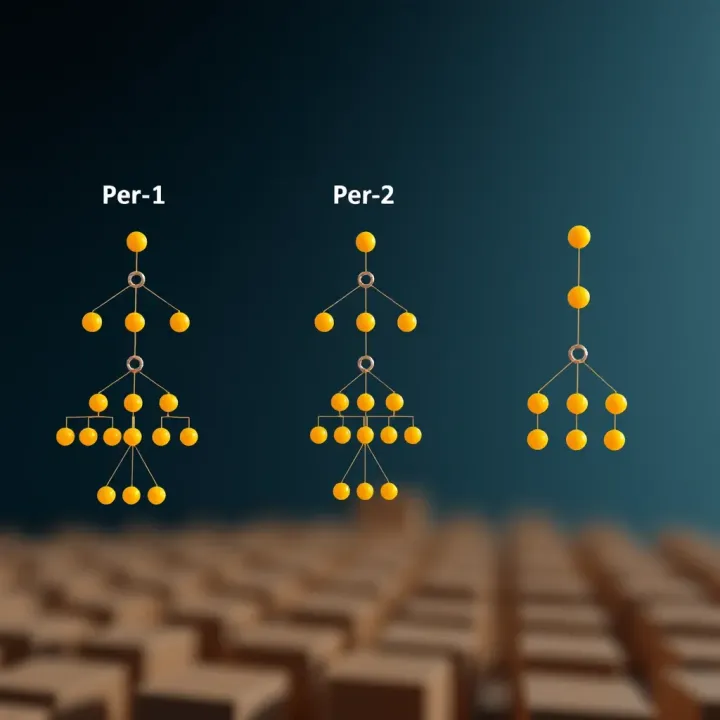
For example, consider a tree where both a parent and child lie on the same vertical line; the child node then blocks the parent from the bottom view, as it appears lower. This differs from the top view which shows nodes visible from above.
The top view presents nodes visible from above the tree. It picks the uppermost node at each horizontal distance from the root. Practically, this helps in visualising what would be seen if you looked down from a drone over a network, showing nodes that lie on the upper layers. It is commonly used in layout calculations, where the highest nodes need prominence.
The left view captures nodes visible when looking sideways from the tree's left edge. It lists the first node encountered at each level moving downwards, offering insights into the tree’s leftmost structure. This view is helpful when analysing trees layer by layer, ensuring all left boundary nodes are covered — especially when visualising execution flow or parsing cascading dependencies.
The right view is the counterpart to the left view, showing nodes visible from the right side. It selects the last node visible at each level when observed from the right edge. The right view is practical in scenarios like visual debugging where you need to understand the breadth on the tree's opposite side without traversing every node.
These distinct perspectives on tree structure help to solve specific problems related to layout, routing, or visualisation. Understanding their differences is key before computing any particular view like the bottom view.
Each view, including bottom, top, left, and right, has unique importance depending on the problem you face. Picking the right one simplifies tree analysis and makes coding algorithms more straightforward and purposeful.
Computing the bottom view of a binary tree helps in visualising which nodes are visible when looking at the tree from below. Using efficient techniques ensures accurate results, especially for large or skewed trees. The key lies in tracking the horizontal position of each node and managing the order in which nodes are processed. This section explains how level order traversal combined with horizontal distances can effectively extract the bottom view.
Level order traversal visits nodes level by level, making it easy to process nodes in top-down order. By assigning a horizontal distance (HD) to each node—starting from 0 at the root, decreasing by one on moving left, and increasing by one on moving right—we can map nodes to their positions across the horizontal axis. For instance, if the root is at HD 0, its left child is at HD -1 and right child at HD 1.
By traversing the tree level-wise and updating the node data associated with each HD, the last node encountered at a particular HD during traversal represents the bottom view for that horizontal position. This method straightforwardly accounts for nodes hidden behind others when viewed from the bottom.
A queue supports level order traversal by storing nodes along with their HDs. When a node is dequeued, its children are enqueued with their corresponding HDs. A map (or dictionary) stores the most recent node’s value encountered at each HD, replacing any previous nodes at the same HD.
For example, while traversing, if a node at HD 2 is found after another node at HD 2, the newer node’s value overwrites the earlier one in the map. After the traversal completes, iterating through the map sorted by HD yields the bottom view nodes from leftmost to rightmost.
Certain scenarios require extra care. Skewed trees (all nodes on one side) take linear time but can cause memory issues if not managed properly. Trees with duplicate values or varying depths might obscure which node to show in the bottom view.
To handle large trees, it’s crucial to keep the space complexity low by pruning unnecessary data and ensuring that the queue and map do not grow excessively. Use iterative approaches instead of recursive ones to avoid stack overflow. When memory is a constraint, carefully designing the data structures and possibly processing in chunks can help.
Tracking horizontal distances during a level order traversal is the cornerstone of extracting the bottom view efficiently and accurately.
Together, these techniques provide a robust framework for computing the bottom view of a binary tree—with clear mapping of each node’s position and efficient traversal that honours visibility from below.
Imagine a binary tree structured like this:
    20
   /  \
 8     22
/ \      \
5 3 25
/ \
10 14
Here, 20 is the root node. Its left child is 8, and right child is 22. The tree extends downward with nodes 5, 3, 25, 10, and 14. This example is small enough to follow easily, yet it presents enough complexity to demonstrate key aspects of bottom view extraction.

### Tracking Nodes by Horizontal Distance

The core idea behind bottom view computation revolves around horizontal distances (HD). The root starts with an HD of 0. Moving left reduces HD by 1, moving right increases HD by 1.

- Node 20 is at HD 0.
- Node 8 is at HD -1 (one step left).
- Node 22 is at HD +1 (one step right).
- Node 5 at HD -2 (two steps left).
- Node 3 at HD 0 (left child of 8).
- Node 25 at HD +2.
- Node 10 at HD -1.
- Node 14 at HD +1.

As we traverse level by level, we update the node visible at each horizontal distance with the latest (lowest level) node found at that HD. This method ensures that nodes hiding behind others in the bottom view get replaced as we explore deeper levels.

### Final Bottom View Output

After completing the level order traversal while monitoring horizontal distances, the bottom view for the sample tree looks like this:

- HD -2: Node 5
- HD -1: Node 10
- HD 0: Node 3
- HD +1: Node 14
- HD +2: Node 25

So, the bottom view nodes are `[5, 10, 3, 14, 25]` when listed from left to right by horizontal distance.

> This step-by-step process shows how only the lowest nodes at each horizontal distance remain visible from the bottom, giving the distinct "bottom view" shape.

By walking through these steps concretely, learners and professionals alike can better implement the bottom view logic in their code or visualise it in tree-related problems, especially important in interview scenarios or algorithm studies.

## Practical Applications and Significance


### Usage in Visualization and Data Representation

Visualisation is a key aspect where the bottom view aids in simplifying complex tree structures. For instance, when representing hierarchical data like organisational charts or file systems, the bottom view offers a clear snapshot of the nodes that are not overshadowed by others vertically. This can help UI/UX designers create more intuitive interfaces where users see only the most relevant or "visible" data points from a specific perspective. Additionally, database structures or XML document trees can be visualised using bottom views to reduce clutter and highlight leaf-level or lower-level data nodes.

### Role in Network Routing and Hierarchical Systems

In network routing, especially within hierarchical topologies such as telecom or computer networks, identifying the lowest visible nodes in a routing tree is essential. The bottom view of a binary tree can metaphorically represent how routing tables might prioritise certain paths or endpoints. For example, in sensor networks deployed in distributed areas, bottom view calculations help understand nodes that remain active or visible for communication without being hidden by higher-level nodes. This assists in optimising routing protocols to reduce latency and improve network reliability.

### Relevance in Competitive Programming and Interviews

Competitive programming contests and software engineering interviews often test one’s grasp of tree traversals and views. Bottom view problems check the candidate’s ability to combine concepts such as level order traversal, horizontal distances, and data structure usage efficiently. Employers and educators favour this topic because it examines problem-solving skills, spatial thinking, and algorithm optimisation simultaneously. Preparing for such problems can sharpen one’s coding and logical skills, which are valuable in many real-world software development tasks.

> The bottom view is not just a visual perspective but a strategic tool that simplifies hierarchical data understanding, network optimisation, and sharpens algorithmic thinking useful in coding challenges.

By recognising where the bottom view applies, you can better appreciate its role in both academic exercises and practical, everyday applications in tech and business. This leads to more intuitive designs, efficient data handling, and stronger coding competencies for those working with tree data structures.

## Common Challenges and Optimising Bottom View Computations

Calculating the bottom view of a binary tree may seem straightforward at first glance, but several challenges can pop up during implementation. Understanding these hurdles helps in producing solutions that are both efficient in time and space, which is especially important when dealing with large or skewed trees common in real-world applications.

### Managing Time and Space Complexity

The biggest challenge lies in balancing time and space complexity. Bottom view computations generally involve traversing the tree using level order traversal while tracking horizontal distances. This activity typically requires O(n) time, where n is the number of nodes, since each node needs to be visited once.

However, the space complexity is also significant because you store node references in a queue and maintain a map of horizontal distances to node values. For very large trees, this could mean high memory usage. For instance, a tree representing a company's organisational hierarchy or a network routing structure might easily have lakhs of nodes, so inefficient storage can lead to slowdowns or memory overflow.

### Dealing with Skewed and Large-Scale Trees

Skewed trees, where nodes have only one child repeatedly to the left or right, present a unique challenge. Since horizontal distances can skew heavily in one direction, the map storing these distances could expand unnecessarily. This might lead to an unbalanced workload and unnecessary computations.

Large-scale trees, which are common in databases or large-scale network systems, require optimisations such as pruning unnecessary branches early or parallel processing to manage data efficiently. Without these, even an optimised approach could struggle with latency and resource utilisation.

### Best Practices for Efficient Implementation

To manage these challenges, a few practices work well:

- **Use Hash Maps (Dictionaries) for Horizontal Distance Tracking:** Quick lookups and updates keep performance smooth.
- **Employ Queue-based Level Order Traversal:** It ensures nodes are processed in the right sequence.
- **Avoid Processing Null Nodes:** Helps to save unnecessary operations.
- **Early Pruning:** Skip branches that won’t influence the bottom view.
- **Memory Management:** Reuse data structures and clear them when finished.

> Efficient algorithms not only save time and memory but also improve maintainability and scalability, which is vital for production-grade applications.

Implementing these tactics can mean the difference between a basic solution and a robust, scalable system ready for real-world demands. For example, in coding interviews or competitive programming, clear and efficient code handling these nuances often scores better. Meanwhile, practical applications like visualising network connections or hierarchical data become easier and faster with optimised computations.

By focusing on complexities and adapting to the tree’s structure, you can build smarter algorithms for bottom view extraction that handle both small and enormous data sets with confidence.👀 Discover how to find the left side view of a binary tree with clear explanations, traversal methods, practical coding tips, and real-world uses.
Explore how to find the max height of a binary tree 🌳, its importance in CS, and methods to calculate it with examples and algorithms. Learn tree basics!

🌳 Discover how to find the left view of a binary tree with clear steps and programming tips. Perfect for students and developers interested in tree traversal.
Explore the maximum depth of binary trees 🌳, with clear explanations, recursive & iterative methods, complexity insights, coding examples, and real-world uses.
Based on 15 reviews